
Reproduced from The Village Voice

(To read the article on The Village Voice website, either click on the above image or go to www.villagevoice.com/don-quixote-and-jeremy-griffith-solving-the-human-condition-and-completing-the-impossible-dream/.)
The Village Voice’s 12 March 2026 article ‘Don Quixote and Jeremy Griffith: Solving the Human Condition and Completing the ‘Impossible Dream’’, written by David García-Baamonde:
The Unresolved Question at the Heart of the Human Condition
There is a question that has shadowed human life since we first became conscious.
Why, when our highest ideals are to be cooperative and loving, are we also capable of cruelty and division? Why does a species that is capable of extraordinary kindness and sensitivity produce war, exploitation and indifference?
Religions, philosophers and poets recognized this contradiction between seemingly good and evil behaviors in us. Myths of a lost innocence, of a ‘Fall’, appear across cultures, but while they pointed to the conflicted state or condition, they did not explain it.
Reconciling this paradox—understanding this underlying, core issue about ourselves well enough to resolve it—has been humanity’s deepest intellectual and moral quest. However, the ability to explain why we could be good when all the evidence seems to unequivocally indicate we are a deeply flawed, ‘bad’ species, has seemed so unattainable that finding that redeeming explanation has appeared to be an impossible dream.
As the Harvard scientist E.O. Wilson once observed, ‘There is no grail more elusive or precious in the life of the mind than the key to understanding the human condition.’
In the twentieth century, the Australian biologist Jeremy Griffith developed an evolutionary account of this ‘key’, crux issue of our seemingly highly imperfect human condition—one that has drawn support from scientists and scholars internationally. Through the organization Fix The World (formerly the World Transformation Movement), he continues to present this framework as the ‘key’ to humanity’s deepest psychological conflict.
Don Quixote and the Impossible Dream
Long before science attempted such an explanation, literature had already given this underlying, most important and ‘elusive’ search a face: Don Quixote.
The knight of La Mancha rides into battles he cannot win, a seemingly deluded figure armed with little more than conviction. He is beaten, mocked, defeated—and yet he rises again. The word ‘quixotic’ has become part of our vernacular, suggesting both admiration and sorrow—admiration for courage, sorrow for its apparent futility.
In 2002, a Nobel Prize Committee survey of 100 of the world’s best writers voted Cervantes’ Don Quixote ‘the greatest work of fiction ever written’. Fyodor Dostoevsky called it the most profound work in literature. William Faulkner re-read it annually, as others read scripture.
The reverence is not accidental. The novel has such deep, universal appreciation because Cervantes captured something central to the human condition itself—our almost unimaginable courage to try to prove that, despite all appearances, we are indeed worthwhile.

Miguel de Cervantes (1547–1616) by William Kent
In Man of La Mancha, the twentieth-century stage adaptation of Cervantes’ novel, the knight’s determination is distilled into the glorious anthem ‘The Impossible Dream’—‘to fight the unbeatable foe’ and ‘reach the unreachable star’.
The ‘impossible dream’ celebrates the courage of the quest. But again, it does not explain why it feels so necessary.
That cause is what Jeremy Griffith set out to identify.
The Biological Explanation of the Human Condition
At the heart of Jeremy Griffith’s biological explanation of the human condition is a deep insecurity in us humans—a suspicion that we are essentially bad, a flawed species.
Griffith argues that doubts about our fundamental worth arose from a clash between two fundamentally different systems shaping human behavior: our gene-based instincts and our nerve-based conscious intellect.
Instincts, naturally selected over millions of years, could only orientate behavior. But when a fully conscious mind emerged some two million years ago—a development reflected in the dramatic expansion of cranial capacity evident in the fossil record—it began to experiment, to question and override instinct in its search for understanding. In doing so, it inevitably clashed with those instincts. Genes can orientate; but they are ignorant of the nerves need to understand.
Without an explanation for this conflict, the emerging intellect could only perceive the opposition from the instincts as condemnation—as if it were fundamentally at fault. But to continue to search for knowledge it had to keep pushing against that resistance, and the only tools available were to attack the criticism, refute it, and block it out. The resultant anger, egocentricity and alienation were, in Griffith’s account, not moral failures but necessary defensive responses—the armor of a mind struggling to justify its right to think, to understand.
It follows that if the conflict can be understood—if the intellect recognizes that it had to defy its instincts in order to fulfil its potential—it no longer needs to justify itself through the artificial defenses of anger, egocentricity and alienation. The basis of human behavior can shift from defensive self-justification to secure self-understanding!
This is why Professor Harry Prosen, a former President of the Canadian Psychiatric Association, described this instinct-versus-intellect explanation of the human condition as ‘the holy grail of insight we have sought for the psychological rehabilitation of the human race.’
Recognition of Jeremy Griffith’s Breakthrough
Prosen’s response is not isolated. Jeremy Griffith’s biological explanation of the human condition, presented most fully in his book FREEDOM: The End Of The Human Condition, has drawn serious engagement from scientists and scholars internationally.
Professor Scott D. Churchill, a former Chair of Psychology at the University of Dallas, called it ‘the book all humans need to read for our collective wellbeing.’
The Spanish nuclear physicist and former Vice-President of the European Parliament, Professor Alejo Vidal-Quadras—a compatriot of Cervantes—said, ‘A really significant contribution to science, FREEDOM provides enlightening answers to fundamental matters.’ More broadly, he said that Griffith’s introductory presentation, known as THE Interview, ‘deserves spreading to the largest number of people possible.’
Professor Stuart Hurlbert, Professor Emeritus of Biology at San Diego State University, wrote, ‘I am stunned & honored to have lived to see the coming of ‘Darwin II’.’ He explained that after Darwin’s theory of natural selection accounted for the variety of life, Griffith’s work addresses what he regarded as the remaining major questions about humanity’s place and psychological condition.
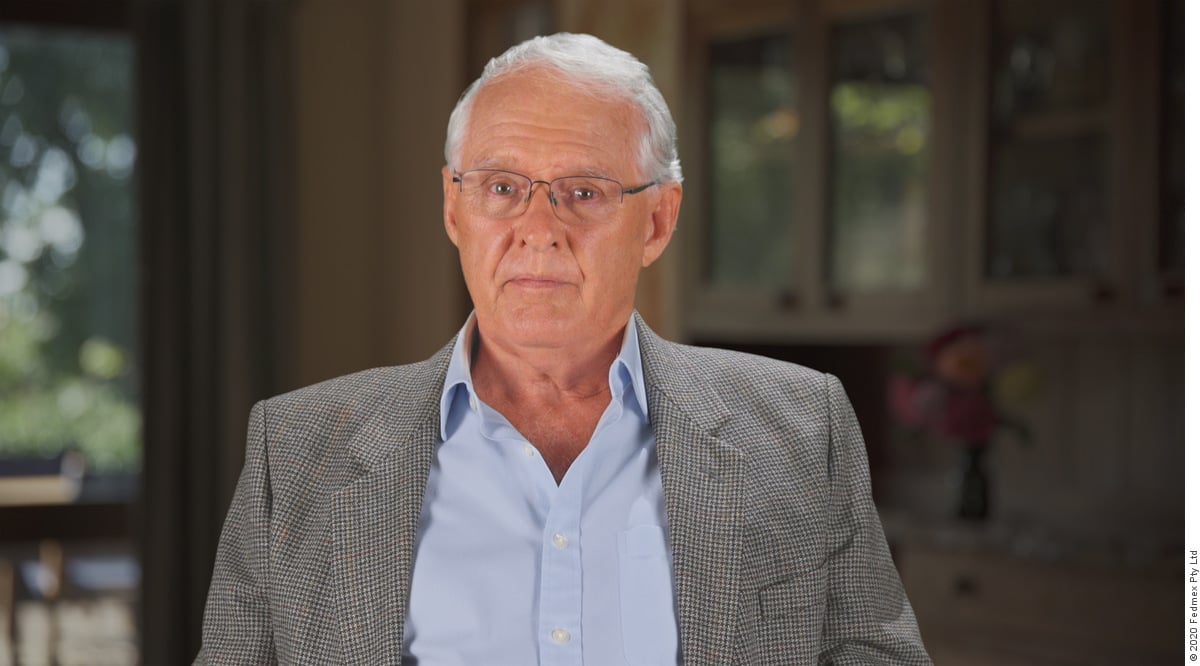
Biologist Jeremy Griffith
Vanquishing Giants
Seen through the prism of Jeremy Griffith’s explanation of the human condition, Don Quixote’s battles take on a profound significance.
What appears as comic delusion is, at a deeper level, the dramatization of psychological necessity. The knight of La Mancha does not simply mistake windmills for giants; he embodies the conscious mind’s refusal to accept condemnation without a fight. His battles are exaggerated and theatrical, but the impulse behind them is recognizable.
Griffith draws the parallel between Quixote’s doomed battles and humanity’s long psychological struggle explicitly. Reflecting on Cervantes’ scene in which Don Quixote charges the windmills, he writes in FREEDOM:
‘And so the crazed and hopeless adventure goes on, gloriously doomed battle after gloriously doomed battle. But that has been the lot of every human for some 2 million years; hopeless battle after hopeless battle, feeble beings charging at and trying to vanquish the ‘outrageous giant’ ignorance-of-the-fact-of-our-species’-fundamental-goodness! Wave after wave of quixotic humans have thrown themselves at that ‘outrageous giant’ of ignorance for eons and eons, as bit by tiny bit they accumulated the knowledge that finally made the redeeming explanation of our human condition possible!’
The giants were misidentified—but the battle itself was real.
In Griffith’s account, that long struggle reaches its resolution. The long effort of countless generations has been fulfilled.
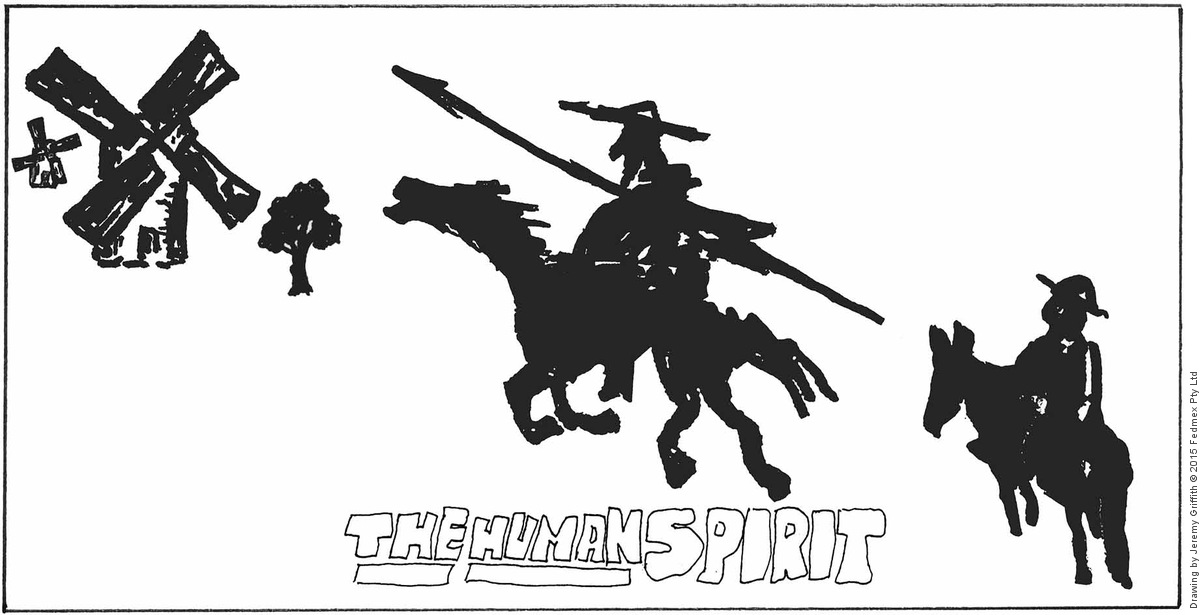
Jeremy Griffith’s drawing in FREEDOM of the courage of the human race as exhibited by Don Quixote
The Renunciation: Disowning What Could Not Yet Be Defended
At the end of Cervantes’ novel, Don Quixote falls ill and renounces his chivalric fantasies. ‘I was mad, now I am in my senses’, he declares.
On the surface, the gesture is clear. The knight disowns the identity that defined him.
But without a biological defense for our seemingly mad behavior, what alternative did Cervantes have? Behavior that appeared irrational could only be called delusion. Anger, egocentricity and alienation, without explanation, could only be condemned.
But while Cervantes could not defend the knight intellectually, he rendered him with unmistakable sympathy—as brave, dignified and sincere.
In Griffith’s view, that sympathy is not sentimental; it is intuitive. In Quixote, we recognize our own long struggle to resolve the human condition. What appeared as madness was the outward expression of that unfinished responsibility.
The Dream Fulfilled
Cervantes placed the meaning of the knight’s quest in a simple declaration by Quixote:
‘Freedom, Sancho, is one of the most precious gifts heaven gave to men; the treasures under the earth and beneath the sea cannot compare to it…for freedom, as well as for honour, one can and should risk one’s life.’
Yes, Don Quixote has endured because he embodies humanity’s courage to strive for the redeeming understanding that would deliver us freedom from the agony and horror of the human condition, even when victory has seemed impossible.
For centuries, humanity marched ‘into hell for a heavenly cause’, striving to overcome what felt like a threat to its worth and goodness. The battles were real, even if the giants were misidentified. The refusal to yield was not madness, but necessity—the determination of a conscious species searching for understanding. A search that has now, through Griffith’s achievement, reached its resolution.
The conflict that shaped our history has been understood. The defense humanity sought has been found.
The unreachable star is grasped.
The dream is realized.
The conflict that defined us is over.
______________________
About the Author
David García-Baamonde is the founder of the Fix The World Madrid Center. He is an airline pilot of over 30 years’ experience. Prior to training at Spain’s National School of Aeronautics, he studied Chemistry at the School of Sciences at the University of Valladolid.
