
Section 3
The significance of Jeremy Griffith’s
life and achievement
3.1 Why Jeremy Griffith was able to confront and solve the human condition
The story of Jeremy Griffith’s life and work ultimately returns to the question at the heart of this book: how was one person able to confront and explain the human condition when humanity—including science—has lived in such profound fear and denial of it?
Again, to draw on philosopher Nikolai Berdyaev’s recognition of not only how difficult confronting the human condition has been for science, but how science’s purpose of finding knowledge ultimately required confronting not avoiding the human condition. He wrote: ‘Knowledge requires great daring. It means victory over ancient, primeval terror [of the issue of our corrupted human condition]. Fear makes the search for truth and the knowledge of it impossible. Knowledge implies fearlessness…it must also be said of knowledge that it is bitter, and there is no escaping that bitterness…Particularly bitter is moral knowledge, the knowledge of good and evil [which is the issue of the human condition]. But the bitterness is due to the fallen [corrupted] state of the world, and in no way undermines the value of knowledge…it must be said that the very distinction between good and evil is a bitter distinction, the bitterest thing in the world…Moral [truthful] knowledge is the most bitter and the most fearless of all for in it sin and evil [the corrupted state of the human condition] are revealed to us along with the meaning and value of life. There is a deadly pain in the very distinction of good and evil, of the valuable and the worthless. We cannot rest in the thought that that distinction is ultimate. The longing for God [ideality] in the human heart springs from the fact that we cannot bear to be faced for ever with the distinction between good and evil [we have to solve the human condition]…Ethics must be both theoretical and practical, i.e. it must call for the moral reformation of life and a revaluation of values as well as for their acceptance. And this implies that ethics is bound to contain a prophetic [human-condition-confronting, denial-free, truthful] element. It must be a revelation of a clear [uncorrupted] conscience, unclouded by social conventions [most particularly unpolluted by the all-pervading attitude of denial]; it must be a critique of pure [innocent, soul-guided] conscience’ (The Destiny of Man, 1931; tr. N. Duddington, 1960, pp.14-16 of 310).
So Berdyaev knew the human condition had to be solved if the human race was to survive—as he said, ‘We cannot rest in the thought that that distinction is ultimate. The longing for God in the human heart springs from the fact that we cannot bear to be faced for ever with the distinction between good and evil’—however, he also recognised that solving it required ‘a prophetic’ ‘critique of pure conscience’ that was ‘unclouded by social conventions’ of denial. Only those who weren’t made to feel ‘worthless’ when thinking about the human condition—that is, only those who hadn’t been exposed to upset in their infancy and childhood and were thus relatively free or innocent of upset; only those with a ‘pure conscience’—could hope to ‘fearless[ly]’ face and investigate the issue of the human condition. Otherwise a ‘deadly pain’ from the ‘ancient [2 million-year-old], primeval terror’ that trying to think about the human condition can cause would be encountered. Recall Carl Jung’s description of how encountering the ‘shadow’, the negative aspects of being human, could be a ‘shattering experience’ because it meant having ‘to gaze into the face of absolute evil’. Since the ideals of our instinctive self or soul are to be cooperative, selfless and loving, the competitive, selfish and aggressive nature of the upset human condition has been the diabolical opposite state to ideality—it has been a ‘bitter’, apparently ‘evil’, ‘worthless’ state.
Yes, as was stated earlier, all the evidence of our behaviour has seemed to unequivocally indicate we are soul-destroying and soul-destroyed, dreadful, awful, ‘worthless’, ‘evil’ monsters! And it is that seemingly undeniable conclusion—that we are apparently ‘the face of absolute evil’—that has been such a ‘shattering experience’ if we allowed our minds to think about it. No wonder virtually everyone has been resigned to hiding ‘a long way underground’ in Plato’s dark ‘cave’ in determined denial of our seemingly appallingly behaved, soul-corrupted ‘human condition’!
So Berdyaev made the point that while virtually everyone has lived in fearful terror of the human condition, ultimately it had to be confronted to be solved. And that was going to require very rare individuals who were fortunate enough to have sufficiently escaped encountering all the upset in the world during their upbringing to be sufficiently uncorrupted in their own soul to not be terrified by the issue of their and the human race’s soul-corrupted human condition—which necessarily is the innocent soundness Jeremy has exhibited in his ability to think truthfully and thus effectively about the human condition. As mentioned earlier, the pre-eminent philosopher Sir Laurens van der Post recognised this need for such sound, truthful thinking when he wrote: ‘He who tries to go down into the labyrinthine pit of himself, to travel the swirling, misty netherlands below sea-level through which the harsh road to heaven and wholeness runs, is doomed to fail and never see the light where night joins day unless he goes out of love in search of love’ (The Face Beside the Fire, 1953, p.290 of 311).
Yes, once again, as the poet Gerard Manley Hopkins wrote about the unbearable ‘cliffs of fall’ of depression that would overcome anyone who tried to confront the human condition if they weren’t sufficiently sound in soul and full of ‘love’: ‘O the mind, mind has mountains; cliffs of fall, frightful, sheer, no-man-fathomed’.
This is what the human race has been waiting for, someone sound enough to confront and by so doing ‘fathom’/solve the human condition, and whenever we thought about that task from our human-condition-terrified positions, it has seemed like an impossible undertaking. But, amazingly, it is that ultimate ‘road’ ‘down into the labyrinthine pit of’ ourselves to achieve ‘heaven and wholeness’ that Jeremy has succeeded in undertaking. Professor Harry Prosen, who studied Jeremy’s work closely, knew him personally for nearly 20 years and became a Patron of FIX THE WORLD, recognised in Jeremy precisely the psychological soundness described above—which gave him the exceptional psychological freedom required to look directly at the issue others had been unable to face. In his Introduction to FREEDOM, Professor Prosen brought together the central themes of Jeremy’s life and achievement:
“[Jeremy Griffith] is the most impressive person and courageous thinker I have ever met and no doubt ever will. Normally people disappoint you at some point, or on some occasions, but Jeremy never does. Basically he is not egocentric. Being exceptionally well nurtured with unconditional love as a child he is sound and secure in himself and as a result is not preoccupied having to prove his worth all the time like most people are. Free of such selfish self-preoccupation he is selflessly concerned only with finding a way to end all the suffering in others, which has resulted in him focusing on finding the solution to the human condition. And being sound and secure in self has meant that in tackling that issue he has been able to think in an unafraid, truthful and thus effective way about it; as Berdyaev foresaw, it was going to ‘require…great daring’ to find ‘knowledge of good and evil’, understanding of the human condition.”
Professor Prosen’s assessment clearly states the significance of Jeremy’s life: he devoted himself to humanity’s most important and most feared problem, confronted what others could not, and found the biological understanding that finally resolves it and ends the core suffering of the human race.

Jeremy’s depiction of our present dystopia caused by our fear of the scorching ‘fire’
(as Plato referred to the unbearable issue of the human condition), and the quenching of
that ‘fire’ by honest, denial-free thinkers—by ‘a prophetic’ ‘critique of pure conscience’
as Berdyaev said—and the resulting liberation of humanity from the human condition
In terms of Jeremy’s amazingly bold undertaking to solve the human condition, it is also significant that Jeremy was born in Australia. Australia was colonised by convicts, who were often notoriously non-conformist, defiers-of-the-dishonest-world-of-denial, relatively innocent Irish—like the non-conformist, establishment-defying, down on his luck but still ‘jolly swagman’ in ‘Banjo’ Paterson’s famous 1895 poem Waltzing Matilda (that is the unofficial national anthem of Australia); and Australia’s most famous outlaw, the non-conformist, ‘you can all get stuffed!’, very Irish bushranger, Ned Kelly. And it is this non-conformist, so-called ‘fair dinkum’, ‘true blue’, ‘no bullshit’ nature that lies at the heart of the Australian character—at least up until recent times when communication technology especially, but also immigration and multiculturalism, has ended our isolation and spread alienation everywhere here as well. Australia has been, as the great writer Albert Camus wrote, a ‘shining land…where so much strength is still untouched’ (Summer, 1954, pp.33-35 of 87). And as the renowned author D.H. Lawrence said in his 1923 novel, Kangaroo, ‘You feel free in Australia…There is a great relief in the atmosphere, a relief from tension, from pressure. An absence of control or will or form [oppression, intimidation and terror from overly embattled, overly-hungry-for-success, out-of-control egos—see chapter 8:16D of FREEDOM]. The sky is open above you, and the air is open around you’ (p.15 of 428). And, in fact, that ‘relief from tension, from pressure. An absence of control or will or form’ provided the freedom for Jeremy to find the understanding of the human condition that will save the human race!
Yes, Australia, with its convict foundations and exceptional isolation, has been the last great bastion of innocence in the modern world. And, strikingly, the central theme in our nation’s mythology is that Australia is where such innocence and soundness will occur to confront and solve the human condition. As Jeremy explains in chapter 9:11 of FREEDOM, titled ‘The ‘pathway of the sun’’, ‘Banjo’ Paterson’s 1890 poem The Man From Snowy River encapsulates the essence of that mythology; indeed, its importance in Australian culture is reflected in the fact that (as depicted below) Paterson’s image appears on Australia’s $10 note, together with all the words of the poem in microprint. Ostensibly, the poem tells of a dangerous ride by mountain horsemen to recapture an escaped thoroughbred that has joined the brumbies (wild horses) in the ranges, but Jeremy identifies the deeper significance in the story: that from Australia’s relative isolation and innocence would emerge the soundness needed to go beyond humanity’s safe denial and retrieve the liberating understanding of the human condition.

Australia’s $10 note features Paterson’s image and, in microprint,
all the many words to his 1895 poem, The Man From Snowy River
At the centre of the poem is a ‘stripling’ ‘lad’—a young boy—on a ‘hardy mountain pony’. When the station owner doubts whether he should accompany the experienced horsemen, the character Clancy insists, ‘I warrant he’ll be with us when he’s wanted at the end.’ And it is the boy who ultimately succeeds where the others cannot, following the brumbies down the ‘terrible descent’, where ‘any slip was death’, and recovering the runaway thoroughbred from the inaccessible mountains. The boy represents the innocence and soundness needed ‘at the end’ of humanity’s long, immensely heroic search for understanding, while his descent into the mountains represents confronting the historically unconfrontable issue of the human condition and retrieving the truth from the depths of denial. In Gerard Manley Hopkins’s words, it represents the ‘fathom[ing]’ of the ‘mind’s ‘mountains; cliffs of fall, frightful, sheer’. In the great Christian mythology, it is the accomplishment of the boy David slaying the giant Goliath world of denial.
So the poem’s deeper significance becomes especially striking in the context of Jeremy’s own life. The young rider who possesses the soundness and courage to go where the others cannot, descend into the danger, recover what has been lost and bring it home, anticipates the very role Jeremy has fulfilled: the Australian thinker sufficiently innocent and secure to confront the human condition, penetrate humanity’s deepest denial, and return with the liberating understanding needed to free the human race. (See paragraphs 1035-1037 of FREEDOM to read more about Jeremy’s relatively innocent ancestry).
3.2 The critical contribution to Jeremy’s work of his mother’s soundness and father’s kindness
The following passages by Jeremy Griffith explain the importance of his mother and father in giving him the security of self required to solve the human condition:
“My mother Jill Griffith (1922-2008) once told me that when she was young she thought of joining a monastery and I understand now that that was because she was such an innocent and naive unresigned person that the dishonest, artificial, deluded, pretentious, alienated, often extremely psychologically upset and corrupted resigned world was an almost unbearable mystery for her also. However, while my mother did think of disassociating from the corrupt world by joining a monastery, her innocent, soul-connected core strength was so great that in the end she decided instead to participate in it, but in a completely defiant, unintimidated, ‘I don’t for one moment accept or go along with all the soul-corrupted, dishonest behaviour’ way—which is where I got my determination to defy the false world from. As I explain in the last paragraph of FREEDOM above the 1959 photograph of my parents, Norman and Jill Griffith (reproduced below), ‘You can see something of the unresigned, human-condition-defying, unaccepting of, even contemptuous of, corrupted reality, no-alienated-nonsense, belief-in-another-true-world, relatively innocent, sound, secure, upright, core strength in my mother that nurtured in me the love of, and belief in, the authentic, instinctive, soulful, true world and defiance of the alienated world of dishonest denial.’
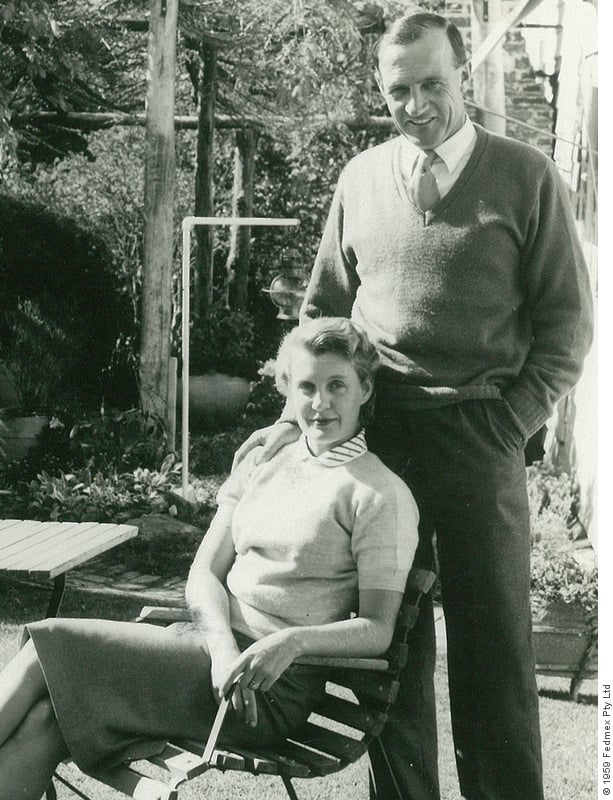
Jeremy’s parents Jill and Norman Griffith in 1959, at their 3,500 acre
sheep station ‘Totnes’, near Mumbil in central west New South Wales
The magnificence of my father Norman (1913-1971) was that he was not at all oppressively egocentric and instead was very saintly, strong but kind, especially never critical or egocentrically pushy and bullying like many men are, which was wonderful and very special for Jill, and for me.
The following two photos of Jill’s mother Enid and grandmother ‘Mackie’ show the exact same extremely independent-of-and-unimpressed-by-the-false-world, upright, sensible, no-alienated-nonsense, core strength expression that Jill had. In paragraph 810 of FREEDOM I explain how this extraordinary defiance of the corrupt world in my mother, in her mother and in her grandmother, is a remnant of the soul strength that all women had long ago when humanity was a nurturing-focused, matriarchal society.”

1963 photo of Jill’s mother Enid
Pountney (later Rush) (1902-1980)

Early 1900s photo of Jill’s grandmother Emily ‘Mackie’ McPherson (1875-1945)
In his writing Jeremy has explained that unlike resigned humans who are living in alienated denial of the truth of their own and the world’s horrifically corrupted condition, exceptional unresigned, denial-free thinkers (individuals we have historically referred to as ‘prophets’) were able to see clearly the horror of the suffering in everyone’s life, and that it was this extreme soul-sensitive ability to see and feel for all the suffering in the world that has been the deeper motivation behind his unrelenting, immense efforts to solve the human condition. His absolute determination and conviction to solve the human condition is perfectly expressed in this phrase, which Jeremy has used in every major document he has written: ‘Soon from one end of the horizon to the other will appear an army in its millions to do battle with human suffering and its weapon will be understanding.’

Jeremy’s re-creation of a 1972 drawing he did when he was 27 years old for a girlfriend to
accompany an astonishingly prescient inspiration he wrote to her about ‘a little boy
leading a great army that was like a thousand wild horses galloping across a vast plain’
In his amazingly insightful Freedom Essay 39 titled Christ explained, Jeremy describes how Christ’s alienation-and-denial-free ability to see and feel all the suffering in the human race similarly motivated his life’s mission. As Christ said, ‘I stood in the midst of the world and…found all men drunken [behaving in a mad way]…And my soul grieves over the sons of men, because they are blind in their heart, and see not [alienated from the truth of their horrifically corrupted condition]’ (Gospel of Thomas, saying 28). Jeremy explained that it was Christ’s extreme unresigned sensitivity to human suffering that led him, in the pre-scientific age in which Christ lived, to realise that he needed to create a religion around his soundness for people to defer to and live through. That religion, which has more followers than any other, is Christianity.
Jeremy also mentions that the great prophet Isaiah felt a similar call to action when ‘the Lord’—which, as Jeremy explains in Freedom Essay 23: Integrative Meaning or ‘God’, is the great overarching truth of the integrative meaning of existence—in effect said to him, ‘“Whom shall I send? And who will go for us?” And I [Isaiah] said, “Here am I. Send me!”’ (Isa. 6:8).
This book’s title, Jeremy Griffith: The biologist who solved the human condition so we can fix the world, reflects this unshakable vision of Jeremy’s to solve the human condition so that the human race is finally in a position to end all the human-condition-stricken suffering, and fix the world. (See Freedom Essay 51: Sir Laurens van der Post’s fabulous vision for much more description of Jeremy’s life-long vision to end the world’s suffering.)
Interestingly, and this is more related to the importance of nurturing than to the motivation of prophets, in 2026 Jeremy wrote the following about the work of two people, who, apart from his own, he says the world needs most at this point in time.
“Firstly, there is the current President of the United States Donald Trump, who has virtually single-handedly stood up to and is putting a stop to the extremely addictive, ‘woke’, socialist, globalist ideology that makes you feel good and by so doing gives you relief from the now unbearable levels of suffering from the agony of the human condition but is actually an extremely selfish and dangerous form of pseudo idealism (as I explain in paragraph 115 of THE Interview, and more fully in my book Death by Dogma). I suspect that the key influence behind Trump’s extraordinary core strength was his mother Mary Anne (1912-2000) who came from the remote western isles of Scotland where some original core soul strength in women must still survive. I don’t know where my mother’s ancestors are from other than that they are from the British Isles, which as a whole have been relatively isolated from all the soul-corrupting upset that has been raging across the world. Unlike the very unusual saintly kindness of my father that kept me free of egocentricity, I think Trump’s father, like most human-condition-afflicted, self-worth-embattled men, was somewhat egocentrically oppressive of Trump’s soul, which has made Trump somewhat egocentric like most men are.

Mary Anne Trump (née MacLeod) in 1930
The second other person whose work I consider most needed in the world today, is that of courageous psychoanalyst Erica Komisar because in her book Being There: Why the First Three Years of Motherhood Matters, and in her many media appearances, Komisar emphasises the critical importance of nurturing infants during the first three years of their life. My ‘instinct vs intellect’ explanation of the human condition explains why the human race’s heroic search for knowledge caused us to become increasingly soul-corrupted with anger, egocentricity and alienation, and how that progression could only be relieved by the finding of the redeeming ‘instinct vs intellect’ explanation of our corrupted condition that we finally now have. In paragraph 75 of THE Interview, I included a graph (below) showing how the ever increasing levels of upset in humans, especially the levels of psychosis/alienation, have been increasing so rapidly lately that the line tracking their rise is near vertical with the amount of upset virtually doubling now in each new generation—such that the human race is entering the terrifying end play state of terminal levels of psychosis. In my various publications I describe this terminal state in dramatic terms, such as how many of the latest Z generation are finding themselves so crippled with psychological pain that they are unable to work, or even leave their house.

The race between self-destruction and self-understanding
What’s missing from all those descriptions is emphasis on the main reason that psychosis has been increasing so rapidly from generation to generation. Commentators blame the overuse of smart phones, and the destructive impact of the internet and social media, but these are only the effects of what is really going wrong. The real reason for the mental health crisis is the rapidly increasing failure of parents to adequately nurture their offspring—which is the danger Komisar has recognised and is alerting the world to, while trying as hard as possible to stop from happening. I pointed out the problem of this rapidly increasing lack of nurturing in chapter 8.16C of FREEDOM, which is titled ‘The dire consequences of terminal levels of alienation destroying our ability to nurture our children’, but my job is to focus on the overall problem of solving, and spreading the actual understanding of, the human condition, which is what has been needed to stop the increase in alienation in parents, and thus stop the increase in their inability to adequately nurture their offspring. What is so important about Komisar’s work is that despite being constantly attacked because, as the saying goes, ‘Parents would rather be accused of being an axe murderer than a bad mother or father’, she has boldly and bravely continued to promote awareness of just how critically important to the welfare of the human race are the first three years of an infant’s life. Two of the many interviews with her about the issue are How a narcissistic society created the mental health crisis (and vice versa) (Alliance for Responsible Citizenship, 21 Feb. 2025), and The Truth about Daycare, Nannies, and Working Moms (The Lila Rose Podcast, 14 Dec. 2023). You can view both at www.fixtheworldsources.com/315.
I might mention that at the beginning of the second of those interviews Komisar says, ‘I feel like women have lost their empathy for their children. Society depends upon healthy children that grow into healthy adults. There is nothing more important than raising children.’ But there actually has been something ‘more important than raising children’ and that has been humanity’s heroic but corrupting search for the redeeming and psychologically healing understanding of the human condition, the alienating effects of which are the reason why ‘women have lost their empathy for their children’. It is really that deeper understanding of our corrupted human condition that has been needed to enable love in all its forms to return to the human race.”
And this is where the redeeming nature of that explanation becomes especially important. It means that even this most sensitive issue of inadequate nurturing can finally be faced without blame, because parents’ diminishing ability to nurture has itself been an inevitable consequence of humanity’s heroic but corrupting search for understanding. The following passage from chapter 6:13 of FREEDOM, titled ‘Nurturing now becomes a priority’, makes the point explicit. As Jeremy explains: “now that we have found that very good reason why parents have been unable to nurture their children with anything like the unconditional love children instinctively expect and need, it is no longer necessary to deny the importance of nurturing both in the maturation of our species and in our own lives. Yes, with the arrival of understanding of the human condition the terrible guilt that parents have felt for not being able to adequately nurture their offspring departs. Parents can now understand that their inability to adequately love their offspring is not their fault, but the product of the ever-accumulating levels of upset in the human race as a whole that resulted from our species’ heroic 2-million-year search for knowledge, specifically for self-knowledge, understanding of why we conscious humans are good and not bad. So yes, we can finally now admit the importance of nurturing and turn our attention back to the nurturing of our offspring—in fact, it now becomes a matter of great urgency that we do both these things.”
