

Back Cover

Contents
Section 1 Brief biography of Australian biologist Jeremy Griffith
1.2 Biology graduate and search for the Tasmanian Tiger
1.3 Founder of Griffith Tablecraft
1.4 Turning to the real issue of the human condition
1.5 Writing, and forming FIX THE WORLD
1.6A The human condition has been the deepest and most important unresolved problem in science
1.6B A summary of Jeremy Griffith’s explanation of the human condition
1.6C The terrible guilt at the heart of the human condition
1.6E Reductionist, mechanistic science could not solve the human condition
1.7 Why Jeremy Griffith works outside the conventional scientific framework
1.7A To solve the human condition Jeremy Griffith had to work outside the ‘peer review’ system
1.7B Solving the human condition required inductive rather than deductive science
1.7C “The most courageous thinker I have ever met”
Section 2 The finding of the human-race-saving explanation of the human condition
2.1 Explaining the human condition has been science’s most important challenge
2.3 Jeremy Griffith’s real explanation of the human condition
2.4 How we acquired our cooperative, selfless and loving moral instincts
2.5 How humans became conscious when other species haven’t, and the Integrative Meaning of existence
2.8 The philosopher Plato defined the extent of our fear of the human condition
2.9 Resignation to living in denial of the human condition
2.10 How humanity’s fear and denial of the human condition shaped science
2.11 Why reductionist, mechanistic science was unable to explain the human condition
2.16 The resistance Jeremy Griffith’s analysis of the human condition encountered
2.18 Solving the human condition makes fixing the world possible
Section 3 The significance of Jeremy Griffith’s life and achievement
3.1 Why Jeremy Griffith was able to confront and solve the human condition
3.2 The critical contribution to Jeremy’s work of his mother’s soundness and father’s kindness
3.3 FIX THE WORLD’s rising sun of freedom from the horror of the human condition
Commendations for Griffith’s treatise
(And you can see more commendations)
From Thought Leaders
‘[Prof. Stephen Hawking] is most interested in your impressive proposal.’
‘In all of written history there are only 2 or 3 people who’ve been able to think on this scale about the human condition.’ Prof. Anthony Barnett, zoologist
‘FREEDOM is the book that saves the world…cometh the hour, cometh the man.’
Prof. Harry Prosen, former Pres. Canadian Psychiatric Assn.
‘FREEDOM is a really significant contribution to science, providing fundamental answers.’ Prof. Alejo Vidal-Quadras, former Vice-Pres. of the European Parliament & nuclear physicist
‘FREEDOM is the rarest gift...it makes sense of the human condition…tells the truth...is next only to the Bible…ends the moral corruption across the world.’
Prof. Yonas Adaye, Addis Ababa Uni & Commissioner, Ethiopian
Dialogue Commission
‘I am stunned and honored to have lived to see the coming of “Darwin II”.’
Prof. Stuart Hurlbert, esteemed ecologist
‘Living without this understanding is like living back in the stone age, that’s how massive the change it brings is!’ Prof. Karen Riley, clinical pharmacist
‘Frankly, I am blown away by the ground-breaking significance of this work.’
Prof. Patricia Glazebrook, philosopher
‘I’ve no doubt a fascinating television series could be made based upon this.’
Sir David Attenborough
From The General Public
‘Griffith should be given Nobel prizes for peace, biology, medicine; actually every Nobel prize there is!’
‘He nailed it, nailed the whole thing, just like the world going from FLAT to ROUND, BOOM the WHOLE WORLD CHANGES, no joke.’
‘FREEDOM will be the most influential, world-changing book in history, and time will now be delineated as BG, before Griffith, or AG, after Griffith.’
‘I’m speechless – this is bigger than natural selection & the theory of relativity!’
‘I really think this man will become recognized as the best thinker this world’s ever seen, and don’t we need him right now!’
‘Griffith has decoded the human species, we FINALLY know what’s going on & the suffering stops!’
‘The world can’t deny this for much longer, let the light in, save the human race!’
‘THE Interview should be globally broadcast daily. The healing explanation humans so sorely need.’
Background
Drawing extensively on the published writings and presentations of Australian biologist Jeremy Griffith, FIX THE WORLD founding members Damon Isherwood and Fiona Cullen-Ward have set out here to explain the significance of a life devoted to humanity’s most important and difficult frontier: understanding and resolving the human condition—the underlying issue in all human life of our species’ extraordinary capacity for what has been called ‘good’ and ‘evil’.
What distinguishes Jeremy’s life and work is his capacity to confront the human condition directly—a subject humanity, including science, has historically found extraordinarily difficult to face and understand. From an early age, Jeremy made this problem the central focus of his life, ultimately developing the redeeming, reconciling and rehabilitating biological explanation for it.
This book is divided into three sections. The first is a brief biography of Jeremy’s life. Sections 2 and 3 then elaborate on the significance of that life and achievement: Section 2 explains why the human condition has been the all-important problem for the human race to solve, why virtually all humans, including scientists, have lived in such mortal fear and denial of the issue that its solution couldn’t be found, how Jeremy had to work outside the prevailing human-condition-avoiding scientific framework in order to find the human-race-redeeming, reconciling and rehabilitating biological understanding of the human condition—the greatest breakthrough in human history—and how that understanding finally makes fixing the world possible. Section 3 then returns to Jeremy himself, explaining why he was able to confront and solve this most difficult of all human problems, the formative influences that gave him the exceptional soundness, security and motivation to do so, and what all this reveals about the significance of his life and achievement.
______________________
Jeremy Griffith has published over 20 books on the human condition, including:
- Beyond The Human Condition (1991), his widely acclaimed second book;
- A Species In Denial (2003), an Australasian bestseller;
- FREEDOM: The End Of The Human Condition (2016), his definitive treatise;
- THE Interview (2020), the transcript of acclaimed British actor and broadcaster Craig Conway’s world-changing and world-saving interview with Jeremy about his book FREEDOM (see second edition in 2026 with the helpful addition Please, Please, Beware The ‘Deaf Effect’!);
- Death by Dogma: The biological reason why the Left is leading us to extinction, and the solution (2021), which presents the biological reason why Critical Theory threatens to destroy the human race;
- The Great Guilt that causes the Deaf Effect (2022), which describes how lifting the great burden of guilt from the human race initially causes a ‘Deaf Effect’ difficulty taking in or ‘hearing’ what’s being presented;
- The Shock Of Change that understanding the human condition brings (2022), which addresses how to manage the shock of change that inevitably occurs when the redeeming understanding of our corrupted condition arrives;
- Therapy For The Human Condition (2023), which is about the therapy that is desperately needed to rehabilitate the human race from our psychologically upset state or condition, elaborating on what is presented in FREEDOM;
- Our Meaning (2023), which explains how being able to know and fulfil the great objective and meaning of human existence finally ends human suffering;
- The Great Transformation: How understanding the human condition actually transforms the human race (2023), which gives a concise description of how the psychological rehabilitation of humans occurs, and how everyone’s life can immediately be transformed;
- AI, Aliens & Conspiracies: The Truthful Analysis (2023), which provides Jeremy’s thoughts on the much discussed question of the danger of Artificial Intelligence (AI), and on the possibility of alien life visiting Earth, and also his explanation for the epidemic of conspiracy theories;
- Sermon On The Beach (2024), which is Jeremy’s elaborated transcript of his inspired description of how the human race now leaves the horror of the human condition forever;
- The Human Condition: What exactly is it, what caused it, and how the human race has finally liberated itself from the horror of it (2025), which is one of Jeremy’s three most important presentations on the human condition, serving as a powerful short-in-length bridge between THE Interview and FREEDOM; and
- Second edition of THE Interview, with the helpful addition Please, Please, Beware The ‘Deaf Effect’! (2026) that warns of, and presents the solution to, the ‘Deaf Effect’ difficulty that most people initially suffer from taking in or ‘hearing’ analysis of the human condition.
Jeremy’s work has attracted the support of such eminent scientists as the former President of the Canadian Psychiatric Association Professor Harry Prosen, the esteemed American ecologist Professor Stuart Hurlbert, the Spanish nuclear physicist and former Vice-President of the European Parliament Professor Alejo Vidal-Quadras, Australia’s Templeton Prize-winning biologist Professor Charles Birch, the former President of the Primate Society of Great Britain Professor David Chivers, world-leading physicist Stephen Hawking, as well as other distinguished thinkers such as the pre-eminent philosopher Sir Laurens van der Post.
Jeremy is the founder and a patron of FIX THE WORLD (formerly World Transformation Movement)—see www.HumanCondition.com.

Created by J. Griffith & G. Salter © 2020 Fedmex Pty Ltd
Section 1
Brief biography of Jeremy Griffith
Please note, Sections 2 and 3 will elaborate on the significance of
Jeremy Griffith’s life and achievement in solving the human
condition, against the backdrop of why it has been humanity’s
most important but psychologically off-limits problem.

Jeremy Griffith in 2013
1.1 Early life and education
Born on 1 December 1945, Australian biologist Jeremy Griffith was raised on a sheep station in rural New South Wales and educated at Geelong Grammar School in Victoria, one of the most highly regarded schools in the world. An indication of the impression he made even at that early age is the remarkable assessment of Gordon Griffiths, a master at ‘Timbertop’, Geelong Grammar’s renowned year-long outdoor education campus, who described Jeremy as the ‘most outstanding, without a doubt’ student he had taught at the school, ‘a brilliant natural historian…[with] an independent spirit’. Jeremy gained first class honours in biology in the state matriculation exams and, in 1965, began a science degree at the University of New England in northern New South Wales. While there, Jeremy played representative rugby union football, making the 1966 trials for Australia’s national team, the Wallabies.
1.2 Biology graduate and search for the Tasmanian Tiger
In 1967, Jeremy Griffith deferred his studies and hitchhiked to Tasmania, determined to save the remarkable dog-like marsupial, the Thylacine, or ‘Tasmanian Tiger’, from extinction, the last known Thylacine having died only 30 years prior to his search. As part of that search he developed what have been credited as the first trail cameras, technology now widely used to monitor threatened wildlife.
Jeremy completed his BSc in zoology at the University of Sydney in 1971 under the tutelage of Templeton Prize winner, Professor Charles Birch (who would later support Jeremy’s work and write the foreword to his 2003 bestseller, A Species In Denial). Jeremy was subsequently offered a scholarship to Stanford University in the USA to continue postgraduate studies in biology, but he chose not to take up the offer, instead continuing his efforts to find and save the Thylacine from extinction that he had begun four years earlier. The search was to last more than six years in total—the most thorough investigation ever into the plight of the Tasmanian Tiger—but sadly Jeremy was to conclude it was extinct. The expedition attracted considerable attention and generated articles in the American Museum of Natural History’s journal, Natural History, and Australian Geographic, and was featured in an episode of the Australian television series A Big Country. Details of the search, including Jeremy’s official report, remain part of a permanent exhibit at the National Museum Australia and are regularly cited in books and articles on the subject, with Jeremy often asked for his knowledge and perspective on the species.

In 1972 Jeremy established a Thylacine Research Centre in Launceston, Tasmania to generate interest, educate the community and log sightings which could then be investigated.
1.3 Founder of Griffith Tablecraft
In 1972, in the same self-sufficient spirit that had driven his ‘Tiger’ search, Jeremy Griffith established Griffith Tablecraft, a highly successful business manufacturing furniture based on his own simple, embellishment-free, natural designs, pioneering the use of unadulterated bark-to-bark slabs of timber, a lovely idea now popular worldwide for tables and bench tops. With Griffith Tablecraft no longer in operation, these unique and beautiful pieces are now considered collector’s items. Jeremy’s creativity also extends beyond his design work, as Jeremy is also an accomplished artist.


© 1990 Fedmex Pty Ltd
Advertisements for Jeremy’s furniture from 1990 Australian home decorating magazines
1.4 Turning to the real issue of the human condition
It was during this time that, in 1973 at the age of 27, Jeremy Griffith realised that trying to save animals from extinction or designing ideal furniture wasn’t addressing the real issue underlying the extraordinary imperfection in human life: our species’ ‘good and evil’-conflicted behaviour, and that what was really needed in the world was a deeper understanding of ourselves. Jeremy therefore turned his attention as a biologist to explaining the human condition, a study that has remained his life’s focus. Jeremy has steadfastly continued his practice of thinking and writing about the human condition (which he does in the early hours of the morning) to the present.

Jeremy with partner Annie Williams at his writing desk in Surry Hills, Sydney in 1982 where he did a great deal of his fundamental thinking about the human condition. Annie typed up all Jeremy’s writing there on a ‘Vydec’, the world’s first word processor, later obsoleted by computers. They also maintained a showroom for Jeremy’s furniture business downstairs there.

Jeremy knew his writing to be so precious that he dug a pit in the backyard at Surry Hills
and put copies of his manuscripts in large glass sealed preservative jars in the pit, covered over with a paving stone to protect them from fire, vandalism or theft.
1.5 Writing, and forming FIX THE WORLD
Jeremy Griffith started writing about the human condition in 1975 and in 1983 established the international not-for-profit FIX THE WORLD, which is dedicated to the study and amelioration of the human condition. He is the author of over 20 books that present his breakthrough ‘Instinct vs Intellect’ biological explanation of the human condition, including his 2003 bestseller A Species In Denial, and in 2016, FREEDOM: The End Of The Human Condition, his “summa masterpiece”.

Annie and Jeremy holding a ‘hot off the press’ first copy of FREEDOM, 2016
1.6 The significance of Jeremy Griffith’s life devoted to finding the scientific explanation of the human condition
1.6A The human condition has been the deepest and most important unresolved problem in science
No scientific challenge has been more profound or consequential than understanding the human condition. As Harvard biologist E.O. Wilson declared in his 2012 book, The Social Conquest of Earth, ‘There is no grail more elusive or precious in the life of the mind than…understanding the human condition.’
It is against the magnitude of that most ‘elusive’ and ‘precious’ challenge that the extraordinary significance of Jeremy Griffith’s life and work has to be understood. Professor Harry Prosen, a former president of the Canadian Psychiatric Association, believed Jeremy had achieved precisely the scientific breakthrough Wilson identified, saying: ‘I have no doubt Jeremy Griffith’s biological explanation of the human condition is the holy grail of insight we have sought for the psychological rehabilitation of the human race.’ (You can view many more similarly impressive endorsements of Jeremy’s treatise from leading scientists and thinkers on FIX THE WORLD’s commendations and reviews page.)
To understand the scale of this achievement, it is necessary to understand what the human condition truly is, why it has been so extremely difficult for humans—including scientists—to confront the subject, let alone solve it, and therefore how remarkable Jeremy is to have done so.
1.6B A summary of Jeremy Griffith’s explanation of the human condition
The elaboration in Section 2 explains all this in detail, but, very briefly, Jeremy Griffith explains that when humans’ fully conscious mind emerged some 2 million years ago (as evidenced by fossil skulls from our evolutionary past indicating expansion of the brain’s association cortex around this time) it started managing our life from a basis of understanding the world. However, our already established naturally selected instinctive orientations to the world inevitably resisted those exploratory experiments in self-management. In effect, our inflexible, ‘dictatorial’, non-understanding instincts criticised our conscious mind for deviating from their established orientations, and unable to explain why our intellect had challenged our instincts, our conscious mind could not resolve the conflict, all it could do was resist the criticism: attack our instincts’ unjust criticism, try to prove it undeserved, and try to block it from its thoughts—we became defensively angry, egocentric and alienated.

1.6C The terrible guilt at the heart of the human condition
What made this situation so much worse was the particular nature of our species’ instinctive orientations to the world—they were not the brutal and savage ‘must reproduce your genes’ instincts that other animals have, but cooperative selfless and loving moral instincts, the ‘voice’ of which is our conscience. As Charles Darwin himself recognised, ‘The moral sense…affords the best and highest distinction between man and the lower animals’. Jeremy Griffith actually explains (and again you can read more about this in the elaboration in Section 2) that our distant ape ancestors developed our extraordinary cooperative, selfless and loving moral instincts through the extended nurturing of infants—which is how the bonobo species of ape are creating their extraordinarily cooperative, selfless and loving behaviour. In fact, following correspondence over the years between Jeremy and renowned primatologist Frans de Waal, in 2010 de Waal observed that ‘There is an increasing consensus among biologists that empathy arrived with the evolution of maternal care in mammals.’
The reason our cooperative, selfless and loving moral instincts made the criticism by our instincts of our conscious mind’s experiments in understanding so much worse is because when we became defensively angry, egocentric and alienated, those behaviours were extremely offensive to our particular cooperative, selfless and loving moral instinctive self or ‘soul’. We, our conscious mind, seemingly for no good reason, had turned Edenic utopia into dystopia, destroyed paradise itself!

Expulsion from the Garden of Eden (detail) by Masaccio, c.1425–27
—humanity’s ancient sense of having corrupted an original state of
innocence has found enduring expression in the story of the Fall.
So the unbearable condemnation from our cooperative, selfless and loving instinctive self or soul meant that our conscious mind had to defensively block it out from our thoughts. In doing so, we became sufferers of ‘psychosis’, which literally means ‘soul-illness’, derived from psyche meaning ‘soul’ and osis meaning ‘abnormal state’.
It is the extreme guilt and shame of having corrupted, destroyed, the original cooperative, selfless and loving world of our instinctive self or soul that is what the human condition is at its deepest level.
It is interesting to note that Jeremy’s obvious-in-hindsight ‘instinct vs intellect’ explanation for our soul-corrupted human condition bears out biologist Allan Savory’s observation that ‘whenever there has been a major insoluble problem for mankind, the answer, when finally found, has always been very simple’.
1.6D Humans, including scientists, have been so terrified of the issue of the human condition that we have lived in denial of it
So it makes sense that while we couldn’t explain our soul-corrupted condition, confronting the guilt and shame of it was so unbearably depressing—in fact, suicidally depressing—that virtually every human had no choice but to live in determined denial of the issue of our 2-million-years-in-development, now horrifically innocence-destroyed, soul-corrupted condition. As is explained in the elaboration in Section 2, the great philosopher Plato wrote that we humans are so afraid of the issue of the ‘human condition’ that we metaphorically hide ‘a long way underground’ in ‘a cave’ so no ‘painful’ light from the ‘sun’ can expose our ‘imperfect’, corrupted ‘condition’. So when the poet Gerard Manley Hopkins wrote, ‘O the mind, mind has mountains; cliffs of fall, frightful, sheer, no-man-fathomed’, he wasn’t exaggerating the depth of depression almost everyone faced if they allowed their mind to think about the human condition while it was still to be ‘fathomed’/understood/answered.
It follows that since science is practiced by humans who are terrified of the issue of our soul-corrupted human condition, science had to develop a detail-only focus, mechanistic, reductionist approach, designed to avoid confronting the unbearable overarching issue of the human condition.

Robert Hooke’s microscope and observations from Micrographia (1665)—an emblem of
science’s reductionist method of understanding nature by examining its component parts.
1.6E Reductionist, mechanistic science could not solve the human condition
One manifestation of mechanistic, reductionist science’s human-condition-avoiding framework is the familiar explanation mentioned above that our competitive, selfish and aggressive behaviour simply reflects savage, must-reproduce-our-genes instincts like those found in other animals—such as saying ‘Our fighting and wars are due to a genetic imperative in us to dominate and be a winner in the reproductive battle of life’.
But, as is made clear in Section 2, that explanation is simply a way of avoiding having to account for the obvious immensely insecure, soul-distressed, psychological nature of our behaviour. We don’t suffer from a genetic-opportunism-driven ‘animal condition’, but a conscious-mind-based, psychologically troubled ‘human condition’.
This failure to confront the human condition illustrates the fundamental limitation of science’s mechanistic, reductionist approach. No wonder the Templeton Prize-winning physicist Professor Paul Davies expressed frustration with mechanistic thinking, saying, ‘I have little doubt that much of the alienation and demoralisation that people feel in our so-called scientific age stems from the bleak sterility of mechanistic thought.’
So, as is explained more fully in Section 2, humanity has been profoundly shaped by its fear and denial of the human condition, and science has been no exception. Its mechanistic, reductionist framework was designed to resist confronting the overarching issue of our deeply psychologically troubled, soul-corrupted human condition.
1.7 Why Jeremy Griffith works outside the conventional scientific framework
1.7A To solve the human condition Jeremy Griffith had to work outside the ‘peer review’ system
In an immensely soul-corrupted, human-condition-stricken world, Jeremy Griffith was extraordinarily fortunate in his upbringing to be exceptionally nurtured with unconditional love, and it is his resulting phenomenal soundness and security of self that enabled him to confront and ultimately solve the human condition. But because this incredibly rare ability of Jeremy’s to confront and think truthfully and effectively about the human condition was at odds with conventional science’s effective prohibition of this psychologically off-limits subject, Jeremy has had to operate independently of it, establishing FIX THE WORLD in 1983 to support his research—a charity that in 2026 has over 80 centres around the world and a vast website where all the information is available for free at www.HumanCondition.com.

Jeremy Griffith aged 6 (1952)
This need for an independent approach also explains why Jeremy’s work has developed outside the traditional peer-reviewed scientific structure. Peer review necessarily evaluates new work through researchers working within established disciplines and prevailing frameworks. In the case of the human condition, that presents a particular problem: if the prevailing scientific framework is mechanistic, reductionist and structured around avoiding confrontation with the human condition, then a thesis that directly confronts and seeks to explain that condition was never likely to gain acceptance from within that framework.
This is consistent with a broader limitation of scientific orthodoxy, identified by the science historian Thomas Kuhn, who observed that, ‘revolutions in science are often initiated by an outsider—someone not locked into the current model, which hampers vision almost as much as blinders would’. Sir James Black, who won a Nobel Prize for the discovery of two of the most successful drugs ever developed by the pharmaceutical industry, was pointing out the limitation of the peer review system when he said, ‘The anonymous peer review process is the enemy of scientific creativity…Peer reviewers go for orthodoxy’.
1.7B Solving the human condition required inductive rather than deductive science
Further, since conventional mechanistic, reductionist science has been dedicated to avoiding the issue of the human condition, the overarching problem of the human condition could not be solved by simply deducing further conclusions from within those existing, denial-based frameworks. It required an inductive approach—one that draws together established observations and knowledge into a new, complete-picture synthesis capable of explaining human behaviour as a whole. As Sir Ronald Aylmer Fisher, the father of modern experimental design, wrote, ‘Inductive inference is the only process known to us by which essentially new knowledge comes into the world.’
1.7C “The most courageous thinker I have ever met”
Given the enormity of the problem Jeremy Griffith set out to solve of the all-important issue of the human condition that humanity, and its vehicle for investigating reality, science, has lived in determined denial of; and the need to think outside that framework of denial to arrive at a genuinely new, whole-picture, human-condition-confronting, fully accountable and thus true explanation of it, as Jeremy has done; and to successfully stand up to, fight and survive the extreme persecution that came with being a complete heretic in the human-condition-avoiding fortress of academic denial of the human condition, as Jeremy did—it is little wonder that after studying Jeremy’s work and knowing him personally for nearly 20 years, Professor Prosen described him as ‘the most impressive person and courageous thinker I have ever met’.

Harry Prosen with Jeremy in Sydney in 2007
1.8 Fixing the world
Most wonderfully, by providing the real defence for why our intellect had to defy our instincts, our artificial defensive behaviours of anger, egocentricity and alienation are made redundant, which means we are finally in a position to fix the world. Yes, with our soul-corrupted human condition now finally explained, a whole new transformed world emerges free of all the agony and horror of the angry, egocentric and alienated human-condition-stricken life. We finally have the means to relieve the underlying psychosis behind all human suffering, bar natural causes. Wars, violence, inequality, poverty, the mental health crisis, polarised politics, etc, can all now end. As Professor Prosen said, the understanding we now have of the human condition ‘is the holy grail of insight we have needed for the psychological rehabilitation of the human race’. Everyone can now leave Plato’s horrifically debilitating metaphorical dark ‘cave’ and rejoice in the warm healing sunshine of the redeeming understanding of ourselves. (Section 2.18 will provide more explanation and description of how being able to understand the human condition makes it possible to end all the horror and suffering of the human condition.)

Section 2
The finding of the human-race-saving
explanation of the human condition
This elaboration on what is presented in Section 1 explains why the human condition has been the all-important problem for the human race to solve, why virtually all humans, including scientists, have lived in such mortal fear and denial of the issue that its solution couldn’t be found, and how Jeremy Griffith had to defy that prevailing human-condition-avoiding scientific paradigm in order to find the human-race-redeeming, reconciling and rehabilitating biological explanation of the human condition—the greatest breakthrough in human history! (Section 3 will then explain what this extraordinary achievement reveals about the significance of Jeremy’s life.)
2.1 Explaining the human condition has been science’s most important challenge
The need for a deeper scientific understanding of humans—and the extraordinary difficulty of achieving it—has been recognised repeatedly in the work of some of the most influential scientific and intellectual figures of the modern era.
Charles Darwin anticipated that evolutionary theory would eventually transform our understanding of humans when, near the end of On the Origin of Species, he predicted that ‘Psychology will be based on a new foundation’ and that ‘Light will be thrown on the origin of man and his history’ (1859, p.488).
More than a century later, the writer and polymath Arthur Koestler argued that humanity still needed ‘a correct diagnosis of the condition of man, based on a new approach to the sciences of life’ (Janus: A Summing Up, 1978, p.20).
The magnitude and importance of that ongoing challenge was captured by the renowned biologist E.O. Wilson, who stated that ‘The human condition is the most important frontier of the natural sciences’ (Consilience, 1998, p.298 of 374), and ‘There is no grail more elusive or precious in the life of the mind than the key to understanding the human condition’ (The Social Conquest of Earth, 2012, p.1).

Darwin, Koestler and E.O. Wilson
At the heart of that challenge is the need to explain why a species capable of extraordinary intelligence, sensitivity and cooperation is also capable of such anger, selfishness, cruelty and violence. In religious terms, why have we been capable of ‘good and evil’? And since our destructive behaviour lies behind so much of the conflict, suffering and devastation in the world, aside from natural phenomena, understanding its cause could not be more important. As psychologist B.F. Skinner put it, ‘The major problems facing the world today can be solved only if we improve our understanding of human behavior’ (About Behaviorism, 1974, pp.8-9). Psychoanalyst Carl Jung was even more explicit, warning that ‘We need more understanding of human nature, because the only real danger that exists is man himself. He is the great danger, and we are pitifully unaware of it. We know nothing of man, far too little. His psyche should be studied, because we are the origin of all coming evil’ (Face to Face, BBC television interview with John Freeman, 1959). And journalist Richard Neville captured the same predicament when he wrote that ‘We are locked in a race between self destruction and self discovery’ (Good Weekend, The Sydney Morning Herald, 14 Oct. 1986).
Together, these observations make the point starkly: until we understand the underlying cause of our psychologically troubled condition and destructive behaviour, humanity cannot hope to fundamentally resolve the crises we see occurring everywhere resulting from that behaviour.
2.2 Why blaming our behaviour on having savage, must-reproduce-our-genes instincts like other animals doesn’t solve the human condition
Despite the immense importance of solving the human condition, the explanation we have traditionally relied on to account for our destructive behaviour has been fundamentally and blatantly untrue.
What everyone has been taught at school, and what we are told in every documentary, is that humans’ competitive, selfish and aggressive behaviour is a product of us having savage, must-reproduce-our-genes instincts like other animals. Certainly while left-wing thinkers do claim we have some selfless, cooperative instincts, they also say we have this selfish, competitive ‘animal’ side, which political philosopher Karl Marx limited to such basic needs as sex, food, shelter and clothing.
Our conversations are saturated with this belief, featuring comments like: ‘We are programmed by our genes to try to dominate others and be a winner in the battle of life’; and ‘Our preoccupation with sexual conquest is due to our primal instinct to sow our seeds’; and ‘Men behave abominably because their bodies are flooded with must-reproduce-their-genes-promoting testosterone’; and ‘We want a big house because we are innately territorial’; and ‘Fighting and war is just our deeply-rooted combative animal nature expressing itself’.

AdobeStock; jeaneeem / Flickr
However, this notion that we have savage competitive and aggressive, must-reproduce-our-genes instincts like other animals cannot be the real reason for our species’ competitive and aggressive behaviour because, after all, words used to describe human behaviour, such as egocentric, arrogant, inspired, depressed, deluded, pessimistic, optimistic, artificial, hateful, cynical, mean, sadistic, immoral, brilliant, guilt-ridden, evil, psychotic, neurotic and alienated, all recognise the involvement of OUR species’ fully conscious thinking mind. They demonstrate that there is a psychological dimension to our behaviour; that we don’t suffer from a genetic-opportunism-driven ‘animal condition’, but a conscious-mind-based, psychologically troubled HUMAN CONDITION.
What’s more, we humans have cooperative, selfless and loving moral instincts—the voice or expression of which we call our conscience—the complete opposite of competitive, selfish and aggressive instincts. As Charles Darwin said, ‘The moral sense…affords the best and highest distinction between man and the lower animals’ (The Descent of Man, 1871, ch.4).
And to have acquired these cooperative, selfless and loving moral instincts our distant ape ancestors must have lived cooperatively, selflessly and lovingly, for how else could we have inherited them? Our ape ancestors can’t have been brutal, club-wielding, competitive and aggressive savages as we have been taught, rather they must have lived in a Garden of Eden-like state of cooperative, selfless and loving innocent gentleness—which, as will be explained more fully shortly in Section 2.4, is a state the bonobo species of ape is currently living in, and which anthropological findings now evidence we did once live in. For instance, anthropologists like C. Owen Lovejoy have reported that ‘our species-defining cooperative mutualism can now be seen to extend well beyond the deepest Pliocene [which is well beyond 5.3 million years ago]’ (‘Reexamining Human Origins in Light of Ardipithecus ramidus’, Science, 2009, Vol.326, No.5949).
Our ape ancestors were innocent, loving, nurturers,
Paleoartist Jay H. Matternes’s unusually honest reconstruction of our ancestor, the 4.4 mya Ardipithecus ramidus, which appeared in the Dec. 2009 edition of Science, which the above mentioned report from C. Owen Lovejoy about our past ‘cooperative mutualism’ also appeared in.

NOT savage, barbaric brutes as they have for so long been portrayed.

It is us humans now who are psychotic angry, egocentric and alienated, seemingly ‘evil’ monsters!
Detail from Jean-Michel Basquiat’s 1982 ‘Untitled’ painting which was sold in May 2017 for US$110.5 million, which, at the time was the sixth most expensive artwork ever sold at auction, no doubt because of its extraordinarily honest portrayal of the true nature of our present horrifically psychologically distressed human condition.

In FREEDOM, Jeremy Griffith critically examines the many permutations of the traditional ‘savage instincts’ excuse, including Social Darwinism, Evolutionary Psychology, Multilevel Selection, the Social Intelligence Hypothesis, the Social Ecological Model and the Self-Domestication Hypothesis. While these theories differ substantially from one another, he explains how they all ultimately rely on inherited, ‘must reproduce our genes’, savage instincts to account for our selfish, competitive and aggressive behaviour, rather than explaining the psychologically troubled human condition itself.
How we acquired our cooperative, selfless and loving moral instincts will, as mentioned, be explained shortly in Section 2.4.
In summary, the ‘savage instincts’ explanation we have been told accounted for our competitive and aggressive human condition is not the real explanation for it.
2.3 Jeremy Griffith’s real explanation of the human condition
If the ‘savage instincts’ explanation is fundamentally and blatantly untrue—if it cannot account for either the psychological nature of our troubled behaviour or our cooperative, selfless and loving moral instincts—then what is the real explanation of the human condition? Jeremy Griffith’s biological explanation answers that question by providing the true source of our competitive, selfish and aggressive behaviour—and, in doing so, reveals what the human condition, at its deepest level, actually is. The account that follows is drawn from chapter 1:3 of Jeremy’s definitive book, FREEDOM: The End Of The Human Condition.
Our human condition is directly related to the emergence of our conscious thinking mind—it is a result of our species having become fully conscious—and once we accept this foundation truth, then the explanation is actually fairly obvious. Clearly, before our species became fully conscious our lives must have been controlled by instincts, as the lives of all other animals continue to be. So the essential question is, what would happen to a species if it became capable of consciously understanding and thus managing its world? If we think about this scenario, what would obviously happen is that the conscious mind would start to take over management from the instincts. And if we think further about that development, we can appreciate that a conflict would have arisen between the already established instinctive management system and the new conscious, understanding-based management system.
Jeremy illustrates this pivotal conflict with a brilliantly simple yet extraordinarily powerful analogy involving a migrating bird that had just acquired a fully conscious mind.
Many bird species are perfectly orientated to instinctive migratory flight paths. Each winter, without ever ‘learning’ where to go and without knowing why, they quit their established breeding grounds and migrate to warmer feeding grounds. They then return each summer and so the cycle continues. Over the course of thousands of generations and migratory movements, only those birds that happened to have a genetic make-up that inclined them to follow the right route survived. Thus, through natural selection, they acquired their instinctive orientation.
So, imagine a flock of migrating storks returning to their summer breeding nests on the rooftops of Europe from their winter feeding grounds in southern Africa. Suppose in the instinct-controlled brain of one of them we place a fully conscious mind (we will call the stork Adam because we will soon see that, up to a point, this analogy parallels the old, pre-scientific Biblical account of Adam and Eve taking the ‘fruit’ (Gen. 3:3) ‘from the tree of…knowledge’ (2:9, 17); that is, becoming conscious). As Adam Stork flies north he spots an island off to the left with a tree laden with apples. Using his newly acquired conscious mind, Adam thinks, ‘I should fly down and eat some apples.’ It seems a reasonable thought but he can’t know if it is a good decision or not until he acts on it. For Adam’s new thinking mind to make sense of the world he has to learn by trial and error and so he decides to carry out his first grand experiment in self-management by flying down to the island and sampling the apples.
But it’s not that simple. As soon as Adam’s conscious thinking self deviates from his established migratory path, his innocent instinctive self (innocent in the sense of being unaware or ignorant of the need to search for knowledge) tries to pull him back on course. In following the flight path past the island, Adam’s instinct-obedient self is, in effect, criticising his conscious mind’s decision to veer off course; it is condemning his search for understanding. All of a sudden Adam is in a dilemma: if he obeys his instinctive self and flies back on course, his instincts will be happy but he’ll never learn if his deviation was the right decision or not. All the messages he’s receiving from within inform him that obeying his instincts is good, is right, but there’s also a new inclination to disobey, a defiance of instinct. Diverting from his course will result in apples and understanding, yet he already sees that doing so will make him feel bad.
Uncomfortable with the criticism his newly conscious mind or intellect is receiving from his instinctive self, Adam’s first response is to ignore the temptation the apples present and fly back on course. As he does so, however, Adam realises he can’t deny his intellect—sooner or later he must find the courage to master his conscious mind by carrying out experiments in understanding. So, continuing to think, he next asks himself, ‘Why not fly down to an island and rest?’ Again, not knowing any reason why he shouldn’t, he proceeds with his experiment. And again, his decision is met with the same criticism from his instinctive self—but this time Adam defies the criticism and perseveres with his experimentation in self-management. His decision, however, means he must now live with the criticism and immediately he is condemned to a state of upset. A battle has broken out between his instinctive self, which is perfectly orientated to the flight path, and his emerging conscious mind, which needs to understand why that flight path is the correct course to follow. His instinctive self is perfectly orientated, but Adam doesn’t understand that orientation.

In short, when the fully conscious mind emerged it wasn’t enough for it to be orientated by instincts, it had to find understanding to operate effectively and fulfil its great potential to manage life. But, tragically, the instinctive self didn’t ‘appreciate’ that need and ‘tried to stop’ the mind’s necessary search for knowledge, as represented by the latter’s experiments in self-management—hence the ensuing battle between instinct and intellect. To refute the criticism from his instinctive self, Adam needed the discoveries that science has given us of the difference in the way genes and nerves process information; in particular, he needed to be able to explain that the gene-based learning system can orientate species to situations but is incapable of insight into the nature of change. Genetic selection of one reproducing individual over another reproducing individual (the selection, in effect, of one idea over another idea, or one piece of information over another piece of information) gives species adaptations or orientations—instinctive programming—for managing life, but those genetic orientations, those instincts, are not understandings. (Note, a more complete explanation of what instincts are is presented in paragraphs 247-248 of FREEDOM.) The nerve-based learning system on the other hand, can, if sufficiently developed, understand change. Nerves were originally developed for the coordination of movement in animals, but, once developed, their ability to store impressions—what we refer to as ‘memory’—gave rise to the potential to develop understanding of cause and effect. If you can remember past events, you can compare them with current events and identify regularly occurring experiences. This knowledge of, or insight into, what has commonly occurred in the past enables you to predict what is likely to happen in the future and to adjust your behaviour accordingly. Once insights into the nature of change are put into effect, the self-modified behaviour starts to provide feedback, refining the insights further. Predictions are compared with outcomes and so on. Much developed, nerves can sufficiently associate information to reason how experiences are related, learn to understand and become conscious of, or aware of, or intelligent about, the relationship between events that occur through time. Thus consciousness means being sufficiently aware of how experiences are related to attempt to manage change from a basis of understanding. What this means is that when the nerve-based learning system became sufficiently developed for consciousness to emerge (which, as has been mentioned, occurred in our hominin ancestors some 2 million years ago, as evidenced by fossils that show expansion of the association cortex around this time) and with it the ability to understand the world, it wasn’t enough to be instinctively orientated to the world—conscious understanding of the world had to be found. The problem, of course, was that Adam had only just taken his first, tentative steps in the search for knowledge, and so had no ability to explain anything. It was a catch-22 situation for the fledgling thinker, because in order to explain himself he needed the very knowledge he was setting out to accumulate. He had to search for understanding, ultimately self-understanding, understanding of why he had to ‘fly off course’, without the ability to first explain why he needed to ‘fly off course’. And without that defence, he had to live with the criticism from his instinctive self and was INSECURE in its presence.
To resist the tirade of unjust criticism he was having to endure and mitigate that insecurity, Adam had to do something. But what could he do? If he abandoned the search and flew back on course, he’d gain some momentary relief, but the search would, nevertheless, remain to be undertaken. So all Adam could do was retaliate against and ATTACK the instincts’ unjust criticism, attempt to PROVE the instincts’ unjust criticism wrong, and try to DENY or block from his mind the instincts’ unjust criticism—and he did all those things. He became angry towards the criticism. In every way he could he tried to demonstrate his self worth, prove that he is good and not bad—he shook his fist at the heavens in a gesture of defiance of the implication that he is bad. And he tried to block out the criticism—this block-out or denial including having to invent contrived excuses for his instinct-defying behaviour, such as the earlier mentioned excuse that our competitive and aggressive behaviour is due to us having savage, must-reproduce-our-genes instincts like other animals. In short, his ANGRY, EGOCENTRIC and ALIENATED state appeared. Adam’s intellect or ‘ego’ (which is just another word for the intellect since the Concise Oxford Dictionary defines ‘ego’ as ‘the conscious thinking self’ (5th edn, 1964)) became ‘centred’ or focused on the need to justify itself—selfishly preoccupied aggressively competing for opportunities to prove he is good and not bad, to validate his worth, to get a ‘win’; to essentially eke out any positive reinforcement that would bring him some relief from criticism and some sense of worth. He unavoidably became SELFISH, AGGRESSIVE and COMPETITIVE.
Basically, suffering upset was the price of his heroic search for understanding. In the words from the song The Impossible Dream from the musical the Man of La Mancha, we had to be prepared to ‘march into hell for a heavenly cause’ (lyrics by Joe Darion, 1965).
Indeed, it is the tragic yet inevitable situation any animal would have to endure if it transitioned from an instinct-controlled state to an intellect-controlled state—its instincts would resist the intellect’s search for knowledge. Adam’s uncooperative and divisive competitive aggression—and his selfish, egocentric, self-preoccupied efforts to prove his worth; and his need to deny and evade criticism, essentially embrace a dishonest state—all became an unavoidable part of his personality. Such was Adam Stork’s predicament, and such has been the basis of our human condition, for it was within our species that the fully conscious mind emerged.
(The recommended introduction to the biological explanation of the human condition is THE Interview, and for further reading we recommend chapter 3 of FREEDOM ‘The Human-Race-Transforming, Real Explanation of The Human Condition’.)
2.4 How we acquired our cooperative, selfless and loving moral instincts
To appreciate just how devastating this conflict between instinct and intellect became, we need to understand something extremely important about the particular instincts our emerging conscious mind was defying—the cooperative, selfless and loving moral instincts that Darwin was quoted earlier as recognising as the ‘highest distinction between man and the lower animals’. And the strength and innateness of this moral impulse was expressed more than 2,000 years earlier by the philosopher Mencius, who wrote that ‘The tendency of man’s nature to good is like the tendency of water to flow downwards’ (Gaozi I (6A), tr. James Legge, 1895, pp.394-396).
But how did humans acquire such loving instincts in the first place? How could a process like natural selection, which ordinarily favours traits that selfishly promote an individual’s genetic success, have produced an instinctive orientation towards selflessness and love? The primatologist Richard Wrangham described this as ‘A question that has lain unsolved at the core of biology ever since Darwin’ (review of E.O. Wilson’s 2019 book Genesis: The Deep Origin of Societies). And incredibly, Jeremy Griffith’s human-condition-confronting, denial-free, truthful thinking that enabled him to solve the human condition, enabled him to solve this mystery as well, explaining that those selfless instincts developed through the prolonged nurturing of our infants—a process he termed ‘Love-Indoctrination’.
A mother’s instinct to care for her offspring is genetically self-interested because it helps ensure the survival of offspring carrying her genes. However, from the infant’s perspective, that nurturing appears unconditionally selfless: the mother provides food, warmth, protection and love without the infant having to give anything in return.
Jeremy explains that it follows that if the infant can remain in infancy for an extended period and be treated with a lot of seemingly altruistic love, it will be indoctrinated with that selfless love and grow up to behave accordingly. And over many generations that behaviour will become instinctive because genetic selection will inevitably follow and reinforce any development process occurring in a species; the difficulty lay in getting the development of unconditional selflessness to occur in the first place, for once it was regularly occurring it would naturally become instinctive over time. In this way, he explains, maternal nurturing provided a means by which an essentially selfish genetic process could produce an instinctive orientation towards genuine selflessness.
Our primate ancestors were particularly suited to this development because their semi-upright posture and free arms from having lived in trees facilitated carrying and caring for dependent infants. Jeremy identifies the extraordinarily nurturing and cooperative great ape species, bonobos, as an illustration of the potential of this process. And as noted earlier, anthropologists like C. Owen Lovejoy are reporting that ‘our species-defining cooperative mutualism can now be seen to extend well beyond the deepest Pliocene [which is well beyond 5.3 million years ago]’.


Bonobo mothers holding their infants


Frans Lanting/Mint Images/Getty Images; Bottom Right: San Diego Zoo
Bonobos nurturing their infants
Bonobos have not completed the Love-Indoctrination process and, as a result, still retain remnants of sexual opportunism and other selfish tendencies. However, despite this incomplete development, they are already extraordinarily cooperative, selfless and loving, as the following quotes evidence.
Bonobo zoo keeper Barbara Bell writes that ‘Adult bonobos demonstrate tremendous compassion for each other…For example, Kitty, the eldest female, is completely blind and hard of hearing. Sometimes she gets lost and confused. They’ll just pick her up and take her to where she needs to go’ (‘The Bonobo: “Newest” apes are teaching us about ourselves’, Chicago Tribune, 11 Jun. 1998).
Primatologist Sue Savage-Rumbaugh says, ‘Bonobo life is centered around the offspring. Unlike what happens among chimpanzees, all members of the bonobo social group help with infant care and share food with infants. If you are a bonobo infant, you can do no wrong…Bonobo females and their infants form the core of the group’ (Sue Savage-Rumbaugh & Roger Lewin, Kanzi: The Ape at the Brink of the Human Mind, 1994, p.108 of 299).
A filmmaker of the French documentary Bonobos says, ‘They’re surely the most fascinating animals on the planet. They’re the closest animals to man [in that they share almost 99 percent of our genetic make-up]…Once I got hit on the head with a branch that had a bonobo on it. I sat down and the bonobo noticed I was in a difficult situation and came and took me by the hand and moved my hair back, like they do. So they live on compassion, and that’s really interesting to experience’ (short accompanying film to the 2011 French documentary Bonobos).
And bonobo researcher Vanessa Woods gives this first-hand account of bonobos’ unlimited capacity for love from her study of them in their home in the Congo basin: ‘Bonobo love is like a laser beam. They stop. They stare at you as though they have been waiting their whole lives for you to walk into their jungle. And then they love you with such helpless abandon that you love them back. You have to love them back’ (‘A moment that changed me – my husband fell in love with a bonobo’, The Guardian, 1 Oct. 2015).
As was also mentioned earlier, following extended correspondence between Jeremy and the renowned primatologist Frans de Waal, in 2010 de Waal observed that ‘There is an increasing consensus among biologists that empathy arrived with the evolution of maternal care in mammals’ (Robin McKie, ‘My bright idea: humans found a nicer way to evolve’, The Observer, 19 Sept. 2010).
(Read a more complete description of Jeremy’s amazingly insightful, fully accountable and thus truthful nurturing explanation for how humans acquired our all-loving, unconditionally selfless moral conscience—our soul—in chapter 5 of FREEDOM ‘The Origin of Humans’ Unconditionally Selfless, Altruistic, Moral Instinctive Self or Soul’.)
2.5 How humans became conscious when other species haven’t, and the Integrative Meaning of existence
Now that it has been explained that we humans have cooperative, selfless and loving moral instincts that were acquired through the nurturing process of ‘Love-Indoctrination’, it is possible to answer another of science’s most important questions: ‘How is it that humans became fully conscious when other species haven’t?’. As will now be extremely briefly summarised, Jeremy’s fully accountable and thus true explanation of how we became conscious depends on first recognising the Negative Entropy-driven, teleological, holistic, ‘Integrative Meaning’ of existence.
Like Jeremy’s explanation of the human condition, and his explanation of the nurturing origins of our moral instincts, these two issues of the origins of our conscious mind and of the meaning of our existence are fundamental questions that science needed to resolve, and that Jeremy’s human-condition-confronting truthful mind has been able to answer.
Since the main purpose of this book is to explain humans’ great fear of the human condition and how Jeremy’s honest thinking was able to solve such a terrifying subject, the questions of how humans became conscious and of the Integrative Meaning of existence distract from this main path of discussion. So to avoid diverting from that main path as much as possible, what follows is an extremely brief summary of Jeremy’s fully accountable and thus true explanations of those two other very important questions.
Basically, Jeremy’s explanation of how humans became conscious is that once humans were able to develop cooperative, selfless and loving instincts, we were able to think in an Integrative-Meaning-compliant, and therefore truthful, effective, meaningful, ‘conscious’ way.
Throughout nature, matter forms increasingly complex and ordered wholes—from atoms and compounds to organisms and societies. Jeremy explains this universal teleological, holistic tendency toward greater order and integration is driven by the law of physics of Negative Entropy—which is sometimes described as The Second Path of the Second Law of Thermodynamics—and calls its overall significance Integrative Meaning. For larger wholes to remain together, their parts must behave cooperatively rather than divisively; in this sense, he argues, selflessness or ‘love’ is fundamental to integration.
Jeremy’s explanation is that our nurturing-induced cooperative, selfless and loving behaviour freed our ancestors to think in accordance with this Integrative Meaning of existence, allowing truthful, effective conscious thought to develop without being blocked by the selfish demands of natural selection. This, he argues, explains why humans became fully conscious while other species have not.
He further explains that once humans became psychologically upset and, as a result, uncooperative, selfish and competitive, the integrative nature of existence became unbearably condemning and therefore had to be denied—which, he explains, is why we deified the Integrative Meaning of existence as a supposedly-unrelated-to-us-concept we have termed ‘God’. And since, as just explained, selfless love is fundamental to integration, this also explains humanity’s recognition that ‘God is love’. Only with our divisive human condition explained and defended could this wider understanding of the Integrative Meaning of existence (and the resulting demystification of God)—and of the origin of human consciousness—be safely acknowledged.
For an excellent short explanation of Integrative Meaning and of how humans became conscious, see Part 1.5 of The Human Condition book. For a more complete description see chapter 4 of FREEDOM ‘The Meaning of Life’, and chapter 7 of FREEDOM ‘What is Consciousness, and Why, How and When Did Humans’ Unique Conscious Mind Emerge?’
To now return to the main path of discussion, which is how our cooperative, selfless and loving moral instincts made the ‘instinct vs intellect’ conflict in us so much worse.
2.6 How our cooperative, selfless and loving moral instincts compounded the ‘instinct vs intellect’ conflict, producing unbearable guilt and shame
The extraordinary significance of having acquired cooperative, selfless and loving instincts is that our emerging conscious mind was not merely defying any dictatorial instincts, which, as the Adam Stork analogy demonstrates, would have been upsetting enough—it was defying moral instincts.
This means that when we humans became competitive, selfish and aggressive in response to the criticism from our instincts, that behaviour was extremely offensive to our particular cooperative, selfless and loving moral instincts. We, our conscious mind, seemingly for no good reason, had turned utopia into dystopia, destroyed the very paradise our instinctive heritage had created!

The Expulsion from Paradise (detail) by Michelangelo, c.1512
—as mentioned, humanity’s ancient sense of having corrupted an original
state of innocence has found enduring expression in the story of the Fall.
This compounded the condemnation from our instincts, making us, our conscious thinking mind, extremely, excruciatingly angry, egocentric and alienated. And while we blocked out from our mind any criticising truth and as a result became separated or alienated from so many truths, the most condemning of all truths that we were blocking out and repressing and alienating ourselves (our conscious thinking self) from was our condemning moral instinctive self or soul; we were having to destroy the most wonderful part of ourselves—but we had no choice because we were being so unjustly condemned by our soul.
Yes, our mind has been EXTREMELY angry, egocentric and alienated—which is the real reason for our capacity for shocking acts of violence, depravity, indifference and cruelty!

So we humans have endured intolerable guilt and shame for not only having defied our instincts, but having defied them in a way that drew tremendous, unbearable condemnation from our particular cooperative, selfless and loving moral instincts!
The consequence therefore of having to repress our cooperative, selfless and loving instinctive self or soul was that we became sufferers of ‘psychosis’, or ‘soul-illness’, drawing on the Greek psyche meaning ‘soul’, and osis meaning ‘abnormal state’. We had become alienated from our own original innocent nature. And since our conscious mind had become profoundly upset, relentlessly preoccupied angrily, egocentrically and alienatedly defending itself against the criticism from our instincts, it suffered from a ‘neurosis’, or neuron or nerve or ‘intellect-illness’. We became extremely psychotic and neurotic, basically, after 2 million years of our upset’s development, soul-dead and mind-mad, which we are seeing the end stage effects of everywhere we look in the world today!
This painting by the artist Francis Bacon captures something of the truth of our extremely psychotic and neurotic, soul-dead and mind-mad condition, with its death-mask-like, twisted, smudged, distorted, trodden-on—alienated—face, and tortured, contorted, stomach-knotted, arms-pinned, psychologically strangled and imprisoned body. Some recognition of the extraordinarily purging honesty of Bacon’s work is the fact that in 2013 one of his triptychs sold for $US142.4 million, becoming, at the time, ‘the most expensive work of art ever sold at auction’ (TIME, 25 Nov. 2013).

Detail from Francis Bacon’s Study for self-portrait, 1976
So we can now appreciate what the human condition really is at its deepest level. It is the extreme guilt and shame we humans have suffered from for having seemingly corrupted and destroyed the original cooperative, selfless and loving world of our instinctive self or soul. Our conscious mind’s necessary search for knowledge had seemingly turned paradise into a world of selfishness, aggression and suffering, leaving us burdened with an unbearable sense of having betrayed our own original goodness.
BUT, it is precisely this seemingly damning evidence about ourselves that Jeremy Griffith’s ‘instinct vs intellect’ explanation finally explains and completely reverses. When all the evidence of our angry, egocentric and alienated behaviour has seemed to unequivocally indicate we are soul-destroying and soul-destroyed, dreadful, awful, evil monsters, Jeremy’s ‘instinct vs intellect’ explanation of the human condition completely reverses this seemingly damning verdict on humanity—it lifts the so-called ‘burden of guilt’ from the human race, it destroys forever the idea that we are guilty, sinful creatures. What appeared to be our shameful, wanton destruction of an original loving, innocent, Edenic, soulful state was not evidence that we were fundamentally bad or evil. Rather, it was the unavoidable—and ultimately heroic—struggle of the conscious mind to break free of instinctive control to pursue its all-important search for understanding, ultimately for self-understanding, understanding of our soul-corrupted human condition.

The explanation of the human condition is redeeming, reconciling and rehabilitating.
Rembrandt’s The Return of the Prodigal Son (detail), c.1663-1669
So, thank goodness we have Jeremy’s redeeming understanding of our corrupted condition that finally brings an end to the now terminal levels of psychological upset and suffering!
2.7 So the real explanation of and solution to the human condition couldn’t be found because humans have been terrified of the whole issue
When the biologist E.O. Wilson wrote, ‘There is no grail more elusive or precious in the life of the mind than the key to understanding the human condition’, he was making the point that while ‘understanding the human condition’ is the most ‘precious in the life of the mind’ ‘grail’ of science, it is also the most ‘elusive’ ‘grail’ because it has been the most psychologically confronting of all subjects for humans to engage with.
In terms of how unbearably confronting—in fact, suicidally depressing—the issue of the human condition has been, the great philosopher Søren Kierkegaard is said to have given the best account of that worse-than-death experience, writing in his aptly titled 1849 book The Sickness Unto Death that ‘the torment of despair is precisely the inability to die [and end the torture of our unexplained human condition]…that despair is the sickness unto death, this tormenting contradiction [of our ‘good-and-evil’-human-condition-stricken lives], this sickness in the self; eternally to die, to die and yet not to die’ (tr. A. Hannay, 1989, p.48 of 179).
So when the great poet Gerard Manley Hopkins wrote about the unbearably depressing subject of the human condition in his (also) aptly titled 1885 poem No Worst, There Is None, his words ‘O the mind, mind has mountains; cliffs of fall, frightful, sheer, no-man-fathomed’ did not exaggerate the depth of depression almost everyone faced if they allowed their mind to think about the human condition while it was still to be ‘fathomed’/understood/answered.

Our ‘mind has mountains; cliffs of fall, frightful, sheer’
The famous psychoanalyst Carl Jung provided an equally stark description of the terrifying nature of the human condition when he wrote: ‘When it [our shadow] appears…it is quite within the bounds of possibility for a man to recognize the relative evil of his nature, but it is a rare and shattering experience for him to gaze into the face of absolute evil’ (Aion: Researches into the Phenomenology of the Self, 1959; tr. R. Hull, The Collected Works of C.G. Jung, Vol. 9/2, p.10). The ‘face of absolute evil’ is the ‘shattering’ possibility that we humans have been living with—if we allowed ourselves to think about it—that having corrupted our all-loving soul’s world we might indeed be a terrible mistake.


Carl Jung (1875–1961)
The extraordinary difficulty of confronting the human condition is illustrated by the fact that, despite the ‘instinct vs intellect’ explanation being remarkably obvious in hindsight, a number of profound thinkers throughout history had recognised its basic elements but were unable to carry that insight through to a complete explanation. The fact that something so seemingly obvious remained unresolved reveals just how psychologically confronting the subject has been. Indeed, as Jeremy Griffith documents in Freedom Essay 4 titled The ‘instinct vs intellect’ explanation is the obvious and real explanation of our condition, as all these great thinkers evidence, there have been a number of thinkers who have been able to recognise the basic instinct and intellect elements involved in creating the human condition. They include Erich Neumann, Paul MacLean, Julian Jaynes, Christopher Booker, William Wordsworth, Ralph Waldo Emerson, William Blake, John Milton, Robert A. Johnson, Bruce Chatwin, Eugène Marais, Arthur Koestler, Fyodor Dostoevsky, Nikolai Berdyaev, D.H. Lawrence and Carl Jung. However, amongst these, those who tried to take their thinking about the human condition deep enough to begin to actually confront the human condition, namely Marais, Koestler, Dostoevsky, Berdyaev, Lawrence and Jung, often suffered profound despair or breakdown.
As will be explained later in Section 3, Jeremy’s ability to confront the human condition and progress those recognised elements through to a complete, redeeming, reconciling and rehabilitating biological explanation was due to the exceptional nurturing with unconditional love he received during his upbringing, which resulted in an exceptionally soul-preserved, sound and secure self that enabled him to plumb the depths of this most terrifying of subjects.
The pre-eminent philosopher Sir Laurens van der Post, the most quoted author in all Jeremy’s books, recognised this need for such exceptionally sound, truthful thinking when he wrote, ‘He who tries to go down into the labyrinthine pit of himself, to travel the swirling, misty netherlands below sea-level through which the harsh road to heaven and wholeness runs, is doomed to fail and never see the light where night joins day unless he goes out of love in search of love’ (The Face Beside the Fire, 1953, p.290 of 311).
2.8 The philosopher Plato defined the extent of our fear of the human condition
The human condition has been such a terrifying subject for most humans (including the scientific fraternity) that they have had virtually no choice but to live in almost complete denial of it. Yes, ours has been a culture of such pervasive dishonesty that it became nearly impossible to unearth the real, human-race-liberating, biological explanation of the human condition. Indeed, the most famous account ever given of the human condition forms the centrepiece of Plato’s most acclaimed work, The Republic, which he wrote so long ago now in 360 where he depicted humans as metaphorically incarcerated as prisoners in a dark cave, deep underground, so fearful are they of the issue of the soul-corrupted imperfection of their lives that the sun has the power to reveal. Plato was such a magnificent philosopher (philosophy being the study of ‘the truths underlying all reality’ (Macquarie Dictionary, 3rd edn, 1998)) that Alfred North (A.N.) Whitehead, himself one of the most highly regarded philosophers of the twentieth century, described the history of philosophy as being merely ‘a series of footnotes to Plato’ (Process and Reality [Gifford Lectures Delivered in the University of Edinburgh During the Session 1927-28], 1979, p.39 of 413). As Plato wrote, ‘I want you to go on to picture the enlightenment or ignorance of our human conditions somewhat as follows. Imagine an underground chamber, like a cave with an entrance open to the daylight and running a long way underground. In this chamber are men who have been prisoners there’ (tr. H.D.P. Lee, 1955, 514; you can also view all these quotes from The Republic that appear here and in section 2.16 highlighted where they actually appear in The Republic at www.fixtheworldsources.com/227). Plato described how the cave’s exit is blocked by a ‘fire’ that ‘corresponds to the power of the sun’, which the cave prisoners have to hide from because its ‘painful’ light would make ‘visible’ the unbearably depressing issue of ‘the imperfections of human life’ (516-517).

Plato’s allegory of the human race having to hide in a dark ‘cave’ to avoid exposure
of the unbearably depressing issue of their ‘imperfect’ ‘human condition’
Yes, when it comes to ‘pictur[ing]’ the all-important issue of ‘the enlightenment or ignorance of our human condition’, ‘enlightenment’ is going to have to overcome the ‘ignorance’ that comes from humans fearfully hiding from the issue metaphorically ‘a long way underground’ in ‘a cave’—which is precisely what Jeremy has done, and precisely why he’s been able to ‘enlighten’ us ‘prisoners’ about the ‘human condition’, and liberate us from that horrifically debilitating existence.

The liberation of humanity from Plato’s horrible dark ‘cave’
where we had to live in denial of the ‘human condition’
(You can watch/read a complete presentation of Plato’s cave allegory in Jeremy Griffith’s Video/Freedom Essay 11: The difficulty of reading FREEDOM and the solution.)
2.9 Resignation to living in denial of the human condition
Since humans obviously aren’t born practising denial of our corrupted condition, the question arises of when have we each adopted it? The answer, as Jeremy Griffith explains in another of his many insightful revelations that his human-condition-confronting, denial-free, honest mind has been able to produce, is that we adopted it during our early teenage years. As Jeremy fully explains in Freedom Essay 30 titled Resignation, and in chapter 2:2 of FREEDOM titled ‘The psychological event of ‘Resignation’ reveals our species’ mortal fear of the human condition’, virtually every adolescent has, until now, had to go through an extremely agonising ‘dark night of the soul’—a confrontation in their mind with the unbearably depressing truth of their and the human race’s soul-corrupted human condition but, unable to explain and understand that devastated state, they had no choice other than to resign themselves to blocking out from their mind that whole intolerably depressing subject.

Catherine Yeulet/iStockphoto; yamasan/AdobeStock; Al Troin/AdobeStock
Adolescents going through the agony of having to resign to living in denial
of the historically unbearably depressing issue of the human condition
This act of Resignation is the most important psychological event to occur in human life, yet it has never been explained and only very rarely acknowledged before now. The result of Resignation is that virtually all adults carry a hidden fear of ever going near the issue of our corrupted condition again, and instead defensively maintain that there’s no such thing as our soul-corrupted condition that needs to be explained. As will be talked more about in Section 2.16, this hidden fear has caused some adults to vehemently resist Jeremy’s human-race-saving explanation of the human condition.
Yes, the human condition has—until now—been a terrifying ‘red line’ virtually all humans learnt never to cross, so much so that, as will be explained next, the human race’s vehicle for investigating reality, science, has built a whole dishonest, false world on the human-condition-avoiding side of that ‘red line’, and left a whole universe of awareness, sensitivity and insightfulness based on truthful thinking on the other side of it! Plato was absolutely right about us living in a fearful ‘cave’-like state of terrible darkness!
2.10 How humanity’s fear and denial of the human condition shaped science
From all that has been explained so far, it follows that to confront the human condition has been an impossible ask for virtually all people—as the great philosopher Nikolai Berdyaev acknowledged: ‘Knowledge requires great daring. It means victory over ancient, primeval terror…it must also be said of knowledge that it is bitter, and there is no escaping that bitterness…Particularly bitter is moral knowledge, the knowledge of good and evil [which is the issue of the human condition]. But the bitterness is due to the fallen state of the world…There is a deadly pain in the very distinction of good and evil, of the valuable and the worthless’ (The Destiny of Man, 1931; tr. N. Duddington, 1960, pp.14-15 of 310). Yes, trying to think about our soul-corrupted, Garden-of-Eden-devastated, innocence-destroyed, ‘fallen’, seemingly ‘evil’ and ‘worthless’ human-condition-stricken state has been an ‘ancient, primeval terror’, a ‘deadly pain’, ‘the bitterest thing in the world’ for virtually all humans—‘knowledge of good and evil’, of the human condition, ‘requires great daring’.
No wonder the zoologist, author and broadcaster Professor Anthony Barnett said to Jeremy Griffith back in 1983 that ‘you are being very arrogant to think you can answer questions on this scale. In the whole of written history there are only two or three people who have been able to think on this scale about the human condition’ (in a recorded interview with Jeremy Griffith, 15 Jan. 1983).
This raises a fundamental question: if the human condition was so psychologically confronting that virtually all humans had to live in Plato’s cave-like state of complete denial of the suicidally depressing subject, how was the human race ever going to find the understanding needed to free itself from that tortured condition? In particular, how was science—humanity’s designated vehicle for inquiry into the nature of the world and our place in it—ever going to find the crucial explanation of the human condition?
The answer is, as Jeremy explains, that science accommodated this unavoidable fear of the human condition by effectively putting the overarching issue itself off-limits and reducing the task of virtually all scientists to understanding the mechanisms and details of how the world works. Science became mechanistic and reductionist: it focused on the parts while avoiding the psychologically confronting whole. The great hope inherent in this strategy was that, by accumulating sufficient understanding of the mechanisms of life and the world, those insights might eventually make it possible for a sufficiently denial-free, whole-view thinker to assemble them into the understanding of the human condition that humanity so desperately needed, which is the precious role Jeremy has fulfilled.
(Read more about science’s human-condition-avoiding, mechanistic and reductionist ways of coping with the human condition in chapter 2:4 of FREEDOM titled ‘How has science coped with the human condition’.)
2.11 Why reductionist, mechanistic science was unable to explain the human condition
While mechanistic, reductionist science had done the essential hard work of building an enormous body of detailed knowledge about the workings of our world, as Jeremy Griffith explains in chapter 2:12 of FREEDOM titled ‘While denial has been necessary, you can’t find the truth with lies’, its human-condition-avoiding approach ultimately left science failure-trapped: the very mode of inquiry that had enabled it to progress also prevented it from providing us humans with the insights about our behaviour we now so desperately need.
The Templeton Prize-winning physicist Professor Paul Davies was recognising this when he said that ‘For 300 years science has been dominated by extremely mechanistic thinking. According to this [whole-view-evading, human-condition-avoiding, mechanisms-only-focused] view of the world all physical systems are regarded as basically machines…I have little doubt that much of the alienation and demoralisation that people feel in our so-called scientific age stems from the bleak sterility of mechanistic thought’ (‘Living in a non-material world—the new scientific consciousness’, The Australian, 9 Oct. 1991).
Biologist Professor Charles Birch, another Templeton Prize-winner who was also Jeremy’s professor of biology at Sydney University and later an appreciative supporter of his work of addressing the human condition, made a similar point when he said, ‘[mechanistic] science can’t deal with subjectivity [the issue of our psychologically distressed condition]…what we were all taught in universities is pretty much a dead end’ (from recording of Birch’s 1993 FIX THE WORLD Open Day address). Birch also perceived the stultifying effects of dishonest, human-condition-avoiding, denial-based, mechanistic thinking when he said, ‘Biology has not made any real advance since Darwin’ (in recorded conversation with Jeremy Griffith, 20 Mar. 1987), and, some 10 years later, that ‘the traditional framework of thinking in science is not adequate for solving the really hard problems’ (Ockham’s Razor, ABC Radio National, 16 Apr. 1997), with the ‘hard[est] problem’ of all for truth-avoiding thinking to solve being the all-important issue of our psychologically distressed, soul-corrupted human condition. As Birch concluded, ‘Biology right now awaits its Einstein in the realm of consciousness studies’ (ibid). Note that since our soul-corrupted human condition is a uniquely human, conscious-mind-induced affliction, ‘consciousness’ has become code word for the issue of the human condition.
The remarkably denial-free, effective thinker Arthur Koestler was another who was frustrated by mechanistic, reductionist science’s avoidance of our species’ conscious-mind-induced, soul-corrupted, psychotic human condition, writing that ‘symptoms of the mental disorder which appears to be endemic in our species…are specifically and uniquely human, and not found in any other species. Thus it seems only logical that our search for explanations [of human behaviour] should also concentrate primarily on those attributes of homo sapiens [namely our fully conscious mind] which are exclusively human and not shared by the rest of the animal kingdom. But however obvious this conclusion may seem, it runs counter to the prevailing reductionist trend. “Reductionism” is the philosophical belief that all human activities can be “reduced” to – i.e., explained by – the [no conscious-mind-based, psychologically troubled human condition involved] behavioural responses of lower animals – Pavlov’s dogs, Skinner’s rats and pigeons, Lorenz’s greylag geese, Morris’s hairless apes [and, as is explained in Section 2.2, the false excuse of blaming our divisive condition on the savage, must-reproduce-their-genes situation that other animals operate under]…That is why the scientific establishment has so pitifully failed to define the predicament of man’ (Janus: A Summing Up, 1978, p.19 of 354). Like Davies, Koestler complained too of ‘the sterile deserts of reductionist philosophy’, making the fundamental point that ‘a correct diagnosis of the condition of man [had to be] based on a new [human-condition-confronting] approach to the sciences of life’ (ibid. pp.19-20), concluding, like Birch, that ‘the citadel they [mechanistic, reductionist scientists] are defending lies in ruins’ (p.192).
No wonder then that one of history’s greatest mechanistic scientists, Sir Isaac Newton, famously lamented that ‘I can calculate the motion of heavenly bodies but not the madness of people.’ Yes, when the philosopher Arthur Schopenhauer wrote that ‘The discovery of truth is prevented most effectively…by prejudice, which…stands in the path of truth and is then like a contrary wind driving a ship away from land’ (Essays and Aphorisms, tr. R.J. Hollingdale, 1970, p.120 of 237), he was recognising the inability of human-condition-avoiding mechanistic, reductionist thinking to find understanding of our ‘madness’.
2.12 Only a scientist working outside the prevailing mechanistic, reductionist paradigm — outside ‘Plato’s cave’ — could solve the human condition
As Plato so insightfully described, humans have lived in a cave of denial about the human condition, and so solving it required an unusually fearless thinker willing to live outside that cave and look directly at what others had been too terrified to see. Jeremy Griffith’s achievement has been to do precisely that: to confront the human condition without the psychological restraints that have historically prevented examination of our ‘good and evil’-conflicted condition, which meant seeking an explanation from outside the prevailing mechanistic scientific paradigm.

Wanderer Above the Sea of Fog by Caspar David Friedrich (c.1818)
In that prevailing paradigm, status and credibility are achieved through being published in a ‘peer-reviewed’ journal, which is one in which the articles it contains have been examined by people with credentials in the article’s field of study before it is published. Obviously, with mainstream science determined to deny the human condition, and with almost all humans unable to confront the human condition, Jeremy’s treatise has not been ‘peer-reviewed’ or published in peer-reviewed scientific journals. But history shows that exclusion from the prevailing scientific establishment is no measure of the ultimate validity or importance of a breakthrough. Again and again, some of science’s most consequential advances have initially come from outside the accepted paradigm, and have been ignored, rejected or ridiculed before later being recognised.
Consider the following examples: opposition to Charles Darwin’s theory of Natural Selection came not just from the clergy, but from the scientific establishment; the biologist Gregor Mendel’s work on genetic inheritance was ignored for decades; the scientist Ignaz Semmelweis’s discovery of the importance of antiseptic procedures to prevent infections was ridiculed; the geologist Alfred Wengener’s theory of continental drift was rejected; the biochemist Paul Boyer’s discovery of the mechanism for the synthesis of ATP, for which he later received the Nobel Prize, was turned down by the Journal of Biological Chemistry; the biochemist Kary Mullis’s paper outlining his discovery of Polymerase Chain Reaction, which today forms the basis of the most common of lab techniques, and for which he was to receive the Nobel Prize, was rejected by both Science and Nature; and there are many, many more examples.
Sir James Black, who won a Nobel Prize for the discovery of two of the most successful drugs ever developed by the pharmaceutical industry, was pointing out this limitation of the peer review system when he said, ‘The anonymous peer review process is the enemy of scientific creativity…Peer reviewers go for orthodoxy’ (Interview by Andrew Jack, ‘An acute talent for innovation’, Financial Times, 2 Feb. 2009).
In his Introduction to Jeremy’s book FREEDOM, Professor Prosen makes this same point about paradigm shifts—which are the epitome of ‘scientific creativity’—having to come from outside the ‘orthodoxy’, also emphasising that nowhere is this requirement to work outside the existing paradigm more necessary than when the subject is the human condition:
“In The Structure of Scientific Revolutions (1970), science historian Thomas Kuhn noted that ‘revolutions are often initiated by an outsider—someone not locked into the current model, which hampers vision almost as much as blinders would’ (from Shirley Strum’s Almost Human, 1987, p.164 of 297). And when it comes to addressing the problem of the human condition this need to think independently of the existing details-only-focused, whole-view-of-the-human-condition-avoiding, mechanistic framework could not be more critical. For someone to be able to explain, and, through that explanation, bring reconciling, ameliorating understanding to our troubled human-condition-stricken lives, they obviously had to be thinking from a position outside that conventional mechanistic paradigm. The situation certainly brings to mind Einstein’s famous comment that ‘We can’t solve problems by using the same kind of thinking we used when we created them’! I might say that I think we have always known that profound insight into human nature wasn’t going to emerge from the ivory towers of intellectualdom, rather it was going to come from the deepest of deep left field, somewhere where some extraordinary untainted clarity of thought might still exist, such as from the backwoods of Australia where these answers are actually from.”
2.13 Why solving the human condition required an inductive, whole-picture approach rather than deductive science
Since conventional mechanistic, reductionist science has been dedicated to avoiding the issue of the human condition, the overarching problem of the human condition could not be solved by simply deducing further conclusions from within those existing, denial-based frameworks. It required an inductive approach—one that draws together established observations and knowledge into a new, complete-picture synthesis capable of explaining human behaviour as a whole.
Two particular discoveries made by mechanistic, reductionist science were crucial to Jeremy Griffith’s whole-picture, ‘instinct vs intellect’ explanation of the human condition that was described earlier in Section 2.3. The first was the discovery of the genetic basis of biological inheritance, culminating in the DNA discoveries of James Watson and Francis Crick, which made it possible to understand that natural selection produces gene-based instinctive orientations to the world rather than conscious understanding of it. The second was neuroscience’s discovery of how nerves can store impressions or memories and, when sufficiently developed, associate those memories to understand cause and effect—ultimately giving rise to consciousness. By drawing these two bodies of knowledge together, Jeremy was able to recognise that conflict was inevitable when the conscious, understanding-based system began taking over management from the pre-existing instinctive orientation system: genes can only orientate, not understand, and so could not ‘appreciate’ the conscious mind’s need to experiment in order to gain understanding—experiments that inevitably involved deviating from those rigid instinctive orientations. That clash between instinct and intellect is the breakthrough insight at the heart of Jeremy’s explanation of the human condition.

Professor Scott Churchill, a former Chair of the Psychology Department at the University of Dallas, recognised the inductive nature of Jeremy’s work, writing that ‘the kind of synthesis offered in Griffith’s book…[aims] to tie together existing data, while correcting and expanding upon the more limited existing interpretations of those data…Such a perspective comes to us not as a simple opinion of one man, but rather as an inductive conclusion drawn from sifting through volumes of data representing what scientists have discovered’ (Review of FREEDOM submitted to New York Magazine, 26 Sept. 2014).
Churchill’s description of Jeremy’s work as an inductive synthesis helps explain how he was able to arrive at something genuinely new. As Sir Ronald Aylmer Fisher, the father of modern experimental design, wrote, ‘Inductive inference is the only process known to us by which essentially new knowledge comes into the world’ (The Design of Experiments, 1935). (You can read more about the difference between inductive and deductive science in chapter 2:4 ‘How has science coped with the issue of the human condition’, and chapter 6:12 ‘The great obscenity’, of FREEDOM.)
Sir Francis Bacon, the father of the scientific method, was one of the first to recognise how hopelessly compromised deductive science can be by the limitations of the practitioner, declaring that ‘The subtilty of Nature far surpasses the subtilty of [our current human-condition-afflicted] sense and intellect; so that men’s fair meditations, speculations and reasonings are a kind of insanity, only there is no one standing by to notice it…The Logic which is in vogue [deductive reasoning] is rather potent for the confirming and fixing [of] errors [rather] than for the investigation of Truth: so that it is more harmful than useful…And so our only hope is in a true Induction’ (Novum Organum; or A True Guide to the Interpretation of Nature, 1620; Book 1, Aphorisms 10-14).
Essentially, ‘true’ ‘induction-derived’ knowledge requires fearless, free, imaginative thinking—as Koestler pointed out: ‘Max Planck, the father of quantum theory, wrote in his autobiography that the pioneer scientist must have “a vivid intuitive imagination for new ideas not generated by deduction, but by artistically creative imagination”’ (The Act of Creation, 1964, p.147 of 751).
And with regard to the human-condition-confronting fearlessness of such a free ‘imagination’, again, the philosopher Nikolai Berdyaev said that ‘Knowledge requires great daring. It means victory over ancient, primeval terror. Fear makes the search for truth and the knowledge of it impossible. Knowledge implies fearlessness…Particularly bitter is moral knowledge, the knowledge of good and evil [which is the issue of the human condition]…Moral knowledge is the most bitter and the most fearless of all for in it sin and evil are revealed to us along with the meaning and value of life’.
So Jeremy’s achievement lay in being sufficiently free of the denial that had constrained conventional science to think in a human-condition-confronting inductive way to draw together the hard won discoveries science had made and distil from them the ‘instinct vs intellect’ conflict that actually explains the human condition.
However, as Jeremy emphasises in paragraph 1278 of FREEDOM, while science has had to avoid confronting the unbearably depressing issue of the human condition until it could be explained, it was this human-condition-avoiding mechanistic, reductionist science that was ultimately the real ‘messiah’ or liberator of humanity, because by uncovering the different ways genes and nerves process information, it finally made the explanation of the human condition possible.
Historically, people have talked about a ‘second coming’ of innocence, but in fact, such exceptionally innocent, denial-free individuals have always appeared from time to time—the Bible, for example, is a collection of the words of the denial-free thinking so-called ‘prophets’ who appeared during the emergence of the Israelite nation. What these denial-free thinkers lacked however, to be able to solve and thus liberate humanity from the human condition, were the crucial understandings mechanistic science had yet to find. Yes, in the vast spectrum of alienation that inevitably developed in humanity’s heroic battle to defeat the ignorance of our instinctive self or soul, and establish that humans are good and not bad, there have always been extremely rare individuals who were sufficiently nurtured with alienation-free, unconditional love in their infancy and childhood to be sound and secure enough in self to confront and think truthfully about the human condition. But until the discipline of mechanistic, reductionist science found understanding of the difference in the way genes and nerves process information, such upset-free, innocent individuals could not make their final contribution and induce the explanation of the human condition from those hard won insights. Mechanistic, reductionist science was tasked with the tedious, hard work of finding the clues that make explanation of the human condition possible—and it has to be emphasised that science is only the peak expression of the courageous effort that every human has exerted to defeat ignorance. In reality, it is ‘on the shoulders’ of 2 million years of human struggle against our soul’s condemnation of us that understanding of our species’ fundamental goodness has finally been found—but soulful soundness, EQ not IQ, was needed in the end to assemble the actual explanation of the human condition from those clues.
It has been like a game of gridiron football where the team as a whole, with one exception, does all the hard work, steadily gaining yardage down the field. Finally, when the side gets within kicking distance of the goal posts, a specialist kicker, who until then has played no part, is brought onto the field. While he—in his unsoiled attire—kicks the winning goal, the victory clearly belongs to the team of exhausted players who did all the ground work. It is human-condition-avoiding mechanistic, reductionist science, ultimately in combination with human-condition-confronting holistic, teleological inductive science—and backed up by humanity as a whole—that is the overall liberator of the human race from ignorance as to our species’ fundamental goodness.
Against all odds—because the issue of the human condition has seemed so incredibly difficult to ever hope to solve—we, the human race as a whole, finally liberated ourselves from the agony and horror of the human condition! As Jeremy has written, having to endure the horrific injustice of being condemned as evil and worthless beings for some 2 million years, we humans must now be considered the fabulously wonderful heroes of the story of life on Earth!
2.14 The truth of the ‘Instinct vs Intellect’ explanation is confirmed by its ability to make sense of all aspects of human life
When understanding of the human condition is finally found, as it now has been, suddenly so many previously inaccessible explanations and insights about human life become accessible. Metaphorically, when the ‘lights are switched on’ in our dark, truth-avoiding, denial-saturated ‘cave’ existence, the ‘light’ of understanding streams in in all directions!
And all these insights into human life confirm the truth of the ‘instinct vs intellect’ explanation of the human condition. Indeed, the strength of a scientific theory is related to the diversity of phenomena it can explain—as the great physicist Stephen Hawking wrote, ‘A theory is a good theory if it satisfies two requirements: It must accurately describe a large class of observations on the basis of a model that contains only a few arbitrary elements, and it must make definite predictions about the results of future observations’ (A Brief History Of Time, 1988).
The evolutionary biologist Stephen J. Gould was applying a similar methodology to Hawking’s when he argued that Charles Darwin’s theory of Evolution by Natural Selection pointed to the coordination of so many pieces of evidence that only his theory could offer a conceivable explanation, and that in this way Natural Selection has, in effect, been proven. Gould wrote, ‘Evolution is an inference from thousands of independent sources, the only conceptual structure that can make unified sense of all this disparate information’ (‘Mr Sophia’s Pony’, Leonardo’s Mountain of Clams and the Diet of Worms, 1988).
The ‘instinct vs intellect’ theory is very similar to Darwin’s in its ability to ‘make unified sense of’ so much ‘disparate information’ and ‘independent sources’ that it is clearly ‘the only conceptual’ explanation, in this case, for the human condition.
The following are just some of the ‘disparate’ issues that the ‘instinct vs intellect’ explanation ‘make[s] unified sense of’, all of which you can find in Jeremy’s definitive book FREEDOM by looking through its index, or by searching the book electronically.
• It finally explains and ends forever our neurotic mind-mad and psychotic soul-dead human condition, making possible the end of loneliness, depression and anxiety;
• It explains the origin of aggression and war amongst humans and brings them to an end;
• It explains and ends the need for materialism, and our need for a superficial, artificial, self-distracting way of living;
• It explains how humans acquired our altruistic ‘soul’ and its cooperation-demanding ‘conscience’;
• It explains how humans became fully conscious and why other animals have not;
• It explains the importance of nurturing in our species’ development and in our individual lives, and the corrupting effects on children of mothers’ inability now to nurture and of fathers’ now extreme egocentricity;
• It explains why bonobos are the most cooperative of all extant apes;
• It provides a truthful explanation of the stages of maturation of infancy, childhood, adolescence and adulthood that both humanity and humans individually go through;
• It describes and explains the cause of teenage angst, which is the psychological act of Resignation;
• It explains the Negative Entropy-driven integrative, loving meaning of life, and why ‘evolution’ is in fact the purposeful process of ordering matter;
• It explains the extreme limitations of reductionist, mechanistic science and the immense benefits of holistic, teleological science;
• It relates and reconciles the studies of the sciences and of the humanities;
• It explains why and when humans learnt to walk upright, reduced the size of their canine teeth, lost their body hair, began tool use, began hunting and meat-eating, left Africa, and developed language;
• It reconciles science with religion, in the process explaining religion and all manner of religious metaphysics, including the concepts of God, the Trinity, the Virgin Mary, the resurrection, miracles, Judgment Day, the Battle of Armageddon, the stories of Adam and Eve including the Garden of Eden and taking the apple from the Tree of Knowledge, Noah’s Ark and The Flood, Cain and Abel, David and Goliath, after-life, heaven and hell, good and evil, humanity’s ‘fall’;
• It explains and demystifies Christ and the other great prophets;
• It deciphers humanity’s legends and myths about the search for liberating understanding of the human condition such as the story of King Arthur’s Knights of the Round Table’s search for the ‘Holy Grail’, Jason and the Argonauts’ search for the ‘Golden Fleece’, Ulysses’s great adventure and return to Ithaca, The Emperor’s New Clothes, The Man from Snowy River in Australia’s mythology;
• It ends prejudice and inequality between individuals, sexes, ages, generations, races, cultures and civilisations;
• It explains and reconciles the left and right wings of politics, in the process ending the need for politics;
• It replaces the destructively deluded, pseudo idealistic transformation that the New Age, Peace, Green, Climate, Feminist, Indigenous, Animal Rights, Multicultural, Politically Correct, Postmodern, Critical Theory, ‘Woke’, Identity Politics, Great Reset, Socialist, Globalist movements have been trying to introduce with the real psychologically healing transformation of the human condition;
• It explains and heals the ultimate source of all psychological disorders and the alarming mental health crisis in the world;
• It explains and heals the main underlying cause for human sickness;
• It explains sex, heterosexuality, homosexuality, love, physical beauty, the attraction of youth, romance, rape, envy and lust;
• It explains and brings an end to humans’ propensity for paranoia and all manner of conspiracy theories, such as of lost civilisations with advanced technology, and of an invasion of aliens from another planet;
• It explains human sensitivity and creativity, especially in art (including ancient cave painting) and music;
• It explains humour;
• It explains swearing;
• It explains near-death experiences;
• AND it saves the human race from self-destruction and brings peace and happiness to human life!
As Professor Harry Prosen said about FREEDOM, it ‘take[s] humanity from a state of bewilderment about the nature of human existence to a state of profound understanding of our lives. It is a case of having got all the truth up in one go!’ Such is the power of thinking truthfully about the human condition!

All-seeing, unresigned, outside-Plato’s-cave thinking VERSUS
blind, resigned, cave-hiding thinking
How many Nobel Prizes and Knighthoods would adequately recognise that list of accomplishments? Jeremy has fundamentally unravelled the whole mystery of our existence and behaviour, and, above all, made possible the saving of the human race from self-destruction!
The reason this recognition has not yet occurred is that—as has been explained—reductionist, mechanistic science has been designed to avoid/deny human-condition-confronting holistic, teleological, inductive, truthful science. So when, as a result of the discoveries of that human-condition-avoiding reductionist, mechanistic science, understanding of the human condition is finally found, that mechanistic structure finds itself extremely conflicted! Its habituated practice of denial means it struggles to recognise that the ultimate goal of all its efforts has finally been achieved!
What has to happen therefore, is that some mechanistic scientists have to be sound and brave enough to recognise, acknowledge and support the 2-million-year-searched-for explanation of the human condition, and by so doing break the spell of the entrenched denial within the human-condition-avoiding scientific establishment—which is what is now starting to happen, as you will see in the next section.
2.15 Jeremy Griffith’s inductive explanation of the human condition has received significant scientific commendations for its rigour and accountability
Since the human condition is such a confronting subject, and because Jeremy Griffith’s work challenges the prevailing scientific orthodoxy, relatively few scientists have been willing to seriously engage with it. However, among those who have taken the time to study his work closely, the response has often been strikingly positive, with a number of scientists and academics commending the originality of his synthesis, the rigour and accountability with which he develops and supports his argument, and the clarity and explanatory power of his thinking.
The aforementioned Professor Scott Churchill described Jeremy’s work as offering ‘razor-sharp clarifications’ of contemporary thinking on human evolution, saying ‘I have recommended his [Griffith’s] more recent work to my students precisely for his razor-sharp clarifications of positions of contemporary authors like Edward O. Wilson, Richard Dawkins, and Robert Wright. Griffith manages to summarize book-length expositions of these oftentimes obtuse and varying perspectives on human evolution with clarity and brilliance’ (Expert Report, 2007). Anthropologist Professor Walter Hartwig similarly assessed the academic quality of Griffith’s synthesis, writing that ‘The scholarly value is comparable to several of the most celebrated publications in biology’ (Expert Report, 2007). Importantly, University of Cambridge anthropologist and former President of the Primate Society of Great Britain, Professor David Chivers specifically commended the logical structure of Jeremy’s inductive synthesis, writing that ‘The sequence of discussion in FREEDOM is so logical and sensible, providing the necessary breakthrough in the critical issue of needing to understand ourselves.’ And Professor Alejo Vidal-Quadras, nuclear physicist and former Vice-President of the European Parliament, recognised that ‘FREEDOM is a really significant contribution to science, providing fundamental answers.’ While esteemed ecologist Professor Stuart Hurlbert wrote that he was ‘stunned & honored to have lived to see the coming of “Darwin II”.’ See many more Commendations and Reviews.
(For a fuller account of why Jeremy’s explanation is verifiable, testable science—including why it challenges mechanistic science, why it developed outside the traditional peer-review system, and why its inductive approach is scientifically valid—see FTW FAQ 1.10: Why Jeremy Griffith’s explanation of the human condition is verifiable, testable science.)
2.16 The resistance Jeremy Griffith’s analysis of the human condition encountered
While there is growing support for Jeremy Griffith’s now absolutely desperately needed understanding of the human condition, mainstream science is yet to recognise and support it—but that’s what happens with paradigm-shifting, breakthroughs in science. When the physicist Max Planck said ‘Science progresses funeral by funeral’ (Marilyn Ferguson’s reference to a comment by Planck in his Scientific Autobiography, 1948; New Age mag. Aug. 1982; see www.fixtheworldsources.com/174) he was recognising how attached each generation of scientists becomes to the way of thinking they grew up with, and therefore how slow science as a whole is to move to a new paradigm of understanding. The great playwright George Bernard Shaw also warned of how difficult it is to introduce a new paradigm of thinking—especially one that dares to confront the historically unbearably confronting and off-limits subject of the human condition—when he said that ‘All great truths begin as blasphemies’ (Annajanska, 1919). And since the all-important issue for science of our ‘corrupted’, ‘fallen’, ‘good and evil’-conflicted human condition has historically been the most difficult of all subjects for humans to face, it has to be expected that the arrival of the explanation of that condition will, despite its redeeming nature, initially be the most ‘blasphem[ous]’, and thus the most resisted, of ‘all great truths’.
Yes, given humans have lived in a cave-like state of complete denial of the suicidally depressing subject of the human condition, and mechanistic, reductionist science has, as a result, determinedly avoided it, it is not surprising that Jeremy’s work of bringing understanding to the human condition has been viciously persecuted by both the human-condition-avoiding community and the mechanistic scientific establishment—a problem Plato also anticipated; to quote from a summary of Plato’s cave allegory from the Encarta Encyclopaedia: ‘Breaking free, one of the individuals escapes from the cave into the light of day. With the aid of the sun [living free of denial of the human condition], that person sees for the first time the real world and returns to the cave with the message that the only things they have seen heretofore are shadows and appearances and that the real world awaits them if they are willing to struggle free of their bonds. The shadowy environment of the cave symbolizes for Plato the physical world of [false] appearances. Escape into the sun-filled setting outside the cave symbolizes the transition to the real world’ (written by Prof. Robert M. Baird, see: www.fixtheworldsources.com/101). To return to Plato’s own words, ‘if he [the cave prisoner] were forcibly dragged up the steep and rocky ascent [out of the cave] and not let go till he had been dragged out into the sunlight [shown the truthful but at the same time exposing explanation of the human condition], the process would be a painful one, to which he would much object, and when he emerged into the light his eyes would be so overwhelmed by the brightness of it that he wouldn’t be able to see a single one of the things he was now told were real [this ‘Deaf Effect’ inability to absorb discussion of the human condition is what people often experience when they first try to read analysis of the human condition, which readers of Jeremy’s books should be warned about, which Jeremy especially does in his Please, Please, Beware The Deaf Effect addition to THE Interview]’ (The Republic, 515-516). Plato didn’t stop there, going on to say, ‘they would say that his [the person who tries to deliver understanding of the human condition] visit to the upper world had ruined his sight [they would treat him as if he was mad], and that the ascent [out of the cave] was not worth even attempting [those who have attacked Jeremy and his work have typically said, “You won’t succeed in confronting people with the human condition, so what you are doing is not even worth attempting”]. And if anyone tried to release them and lead them up, they would kill him if they could lay hands on him’ (517). Yes, as any psychotherapist knows, denials do fight back with a vengeance when faced with annihilation.
Of course, in today’s civilised world more subtle means than murder were employed in the campaign of persecution against Jeremy to eliminate the threat he posed to the mechanistic, human-condition-avoiding, denial-based ‘cave existence’—for being the person who ‘escape[d] from the cave into the light of day’ and then ‘dragged [humanity] out into the sunlight’. This persecution was the focal point of a 15-year successful legal battle undertaken in the mid-1990s to defend Jeremy’s work in what was, at the time, Australia’s biggest defamation case against our nation’s two largest media organisations, one being our national public broadcaster. Ultimately, the three judges in the New South Wales Court of Appeal unanimously found that an earlier ruling in a lower court did ‘not adequately consider’ ‘the nature and scale of its subject matter’, in particular ‘that the work was a grand narrative explanation from a holistic approach, involving teleological elements’, and other important submissions ‘were not adequately considered by the primary judge’ including that the work can make ‘those who take the trouble to grapple with it uncomfortable’ because it ‘involves reflections on subject-matter including the purpose of human existence which may, of its nature, cause an adverse reaction as it touches upon issues which some would regard as threatening to their ideals, values or even world views’! (See details of the persecution and court case, including this ruling.)
Jeremy has written that “this ‘kill him’-type persecution that FIX THE WORLD has had to endure for daring to break humanity free from its horribly debilitating dark ‘cave’-like existence fails the human race’s 2 million years of conscious thought and enquiry to one day be able to solve the human condition and free ourselves from that horrible existence—avoid becoming extinct from terminal levels of psychosis, which the present mental health crisis in the world evidences we are fast approaching. It is so anti-human, and anti-hope, basically anti-everything the human race has tried to accomplish—it is a crime of the absolute highest order.”

Drawing by Jeremy Griffith © 2014-2025 Fedmex Pty Ltd
2.17 Jeremy Griffith established an organisation devoted to the study of the human condition decades before major institutional initiatives
Jeremy Griffith’s journey in bringing understanding to the human condition and protecting the integrity of that explanation—a 50-year saga—has certainly been a long and torturous one, but bringing understanding to the human condition is the only rational path forward for the human race! Indeed, with the world in such crisis and in desperate need of the all-clarifying, redeeming and ameliorating understanding of all our lives, in December 2012 the billionaire Mortimer B. Zuckerman pledged US$200 million to Columbia University’s ‘accomplished scholars whose collective mission is both greater understanding of the human condition and the discovery of new cures for human suffering’ (The Educated Observer, Winter 2013); and in April 2013 the President of the United States at the time, Barack Obama, announced a ‘Brain Initiative’, giving ‘US$100 million initial funding’ (The Sydney Morning Herald, 4 Apr. 2013) to mechanistic science to also find ‘the underlying causes of…neurological and psychiatric conditions’ afflicting humans (US National Institutes of Health); and, just a couple of months earlier in January 2013, the European Commission announced the launch of the ‘Human Brain Project with a 2013 budget of €54 million (US$69 million)’ with a ‘projected billion-euro funding over the next ten years’ (‘Neuroscience: Solving the brain’, Nature, 2013, Vol.499, No.7458) with the goal of providing ‘a new understanding of the human brain and its diseases’ (Press Release, The Human Brain Project, 28 Jan. 2013) to ‘offer solutions to tackling conditions such as depression’ (‘Scientists to simulate human brain inside a supercomputer’, CNN International Edition, 12 Oct. 2012). In August 2018, the billionaire Tianqiao Chen dedicated US$1 billion to brain research globally, because, ‘With a deeper understanding of our brains, we can have a greater impact on the whole of society. We can seize the power to solve problems which affect all of humanity: suicide, terrorism, depression, anxiety’ (‘A Chinese Billionaire Is Using His Fortune to Unlock the Human Brain’, Bloomberg, 21 Aug. 2018); and in 2019 the respected Wellcome Trust committed £200 million ‘to bring researchers together to improve understanding and treatments for depression and anxiety’, saying ‘Science is essential to answering these questions’ (Press release, ‘Wellcome boosts mental health research with extra £200 million’, 23 Jan. 2019). But establishing an organisation to study the human condition scientifically is precisely the initiative Jeremy took back in 1983 when he created the self-funded FIX THE WORLD (an act of prescience that evidences his clarity and integrity of thought)—an institute that even has the domain name ‘humancondition.com’!
And while these initiatives in the United States, Europe and China are admirable in their quest to seek understanding of the human condition, they are all doing so from the traditional human-condition-avoiding position, which is basically self-defeating, as opposed to the human-condition-confronting position from which Jeremy has already explained it—and yet it is his approach that has been treated as heretical, an anathema and a threat by the mechanistic scientific establishment!!
The sincere hope, however, is that with our species’ predicament now so dire, the scientific establishment will finally acknowledge and support Jeremy’s human-race-saving insight into the human condition. After all, given how unconfrontable the human condition has been, how could Jeremy talk about the subject as freely and accurately as he does if he hadn’t been able to look into it and find the explanation for it?

Jeremy with fellow founding director and now fellow Patron of
FIX THE WORLD, the twice honoured Order of Australia recipient,
Tim Macartney-Snape with his partner Stacy Rodger, 2023
2.18 Solving the human condition makes fixing the world possible

Cartoon by Michael Leunig, Melbourne’s The Age newspaper, 17 Mar. 1984
As Jeremy Griffith emphasises in the following material from his book The Human Condition, finding understanding of the human condition gives us the ‘Understandascope’ the cartoonist Michael Leunig was brilliantly intimating we desperately needed to rehabilitate and transform the human race.
So how does the ‘Understandascope’ of the human condition actually liberate and transform the human race from having to live with the agony and horror of the human condition?
As has now been carefully and fully explained, lacking the real defence of Jeremy’s ‘instinct vs intellect’ explanation for our corrupted condition all we humans have had to cope with the unbearably depressing truth of our corrupted condition are the artificial defences of attacking any criticism of ourselves, of achieving any positive reinforcement of ourselves that we could find, and of denying and blocking out from our mind the condemning truth of our soul-corrupted condition—our angry, egocentric and alienated ways of coping are what have sustained us. But now that we have the real defence for our corrupted condition, all those artificial defences of anger, egocentricity and alienation are obviously no longer needed; they are obsoleted and can end—the result of which is the great transformation of the human race from living with the agony and horror of the human condition to living free of it!
While we now have the psychologically relieving understanding to rehabilitate the human race, the return to a state that is completely free of psychosis and neurosis and alienation will naturally take a number of generations. This is because it usually takes years of psychological healing for all the childhood hurts to our soul and resulting insecurities, confusions and misunderstandings and their effects to be replaced and repaired with understanding, so it follows that in the case of the largest neurosis and psychosis of all of the human condition, that healing process will be a generational process. (See Jeremy’s book Therapy For The Human Condition.)
HOWEVER, while the complete psychological rehabilitation of our species will take a number of generations, WHAT IS OF IMMENSE IMPORTANCE AND IS SO SPECTACULARLY WONDERFUL is that every human can immediately know that they are fundamentally good and not bad, and that this knowledge puts each person in a very powerful position because it means we can legitimately decide not to live in accordance with all the neurological and psychological upset within us.
The logic behind making this decision is irrefutable. As Jeremy writes throughout his books, now that the great goal of the whole human journey of conscious thought and enquiry has been achieved and we have found understanding of our conflicted and distressed human condition, all the old retaliatory, defensive and insecure behaviours of anger, egocentricity and alienation that we had to employ to cope while we couldn’t defend ourselves with understanding are no longer needed. They are obsoleted, brought to an end. In fact, with this knowledge of the human condition now found, it would be an act of total irresponsibility, indeed madness, to continue down that old, insecure, defensive, retaliatory and destructive road. The truth is, there is nothing in the way now of every human taking up a magnificent, unburdened, Transformed Way of Living where we abandon those old, now obsoleted, ways of living.
And, gloriously, what happens when we give up our old way of living and take up the new way of living that understanding of the human condition has made possible, is that we transition from a competitive, selfish and aggressively behaved person to a cooperative, selfless and lovingly behaved person. Even though we are not yet free of the psychologically upset state of our own personal human condition, we can immediately have a change of attitude and decide not to live out that upset state that remains within us. The overall effect in our lives is that, despite the upset state of the human condition that still exists within us, we are EFFECTIVELY free from its hold and its influence, which is an absolutely fabulous transformation to have made!
Every human can, as it were, put the issue of all their mental upsets and soul-corruptions in a ‘suitcase’, attach a label to it saying ‘Everything in here is now explained and defended’, and simply leave that suitcase behind at the entrance to what we in FIX THE WORLD call the Sunshine Highway, and set out unencumbered by all those upset behaviours into a new world that is effectively free of the human condition.

So yes, with understanding of the human condition at last found we are no longer trapped in Plato’s horrible cold, dark cave of denial and delusion, and are free to come out into the warm healing sunshine of the compassionate full truth of the redeeming and dignifying understanding of ourselves. Our insecurity about being corrupted ends. We can finally understand that we are all good and not bad. As Professor Prosen said, the understanding we now have of the human condition ‘is the holy grail of insight we have needed for the psychological rehabilitation of the human race’. And what this means is that all our old artificial and superficial dishonest and deluded ways of coping are no longer needed. We are FREE to leave all those fake and in-truth horrid practices behind as finished with. We can finally transition from living in a dreadful state of denial and delusion to living in a wonderfully TRANSFORMED STATE of freedom from all the dishonesty and delusion that made human life so fraudulent, mad, destructive and chaotic. In fact, all the in-truth extreme shallowness, emptiness and loneliness of that cold and dark, dishonest and deluded, immensely destructive existence is able to be replaced by so much relief, happiness and healthiness now that we will find it almost too exciting to bear! We go from living an existence tortured by the horror of the human condition, to an absolutely fabulous life free of that horror.
And as Jeremy particularly emphasises in paragraph 147 of The Human Condition, solving the human condition is the key to fixing all the crises that are threatening our planet: “Truly, with every day bringing with it more alarming evidence of the turmoil of the human situation, the issue of the human condition is the ONLY question confronting the human race, because its solution has become a matter of critical urgency. Conflict between individuals, ‘races’, cultures, religions and countries abounds (and by ‘races’ I mean groups of people whose members have mostly been together a long time and are thus relatively closely related genetically—people who have a shared history). There is genocide, terrorism, extreme greed and dysfunction, crisis-level migration of peoples, starvation, runaway diseases, environmental devastation, gross inequality, ‘racial’ and gender oppression, polarised politics, rampant corruption and other crimes, drug abuse, family breakdown, and epidemic levels of obesity, chronic anxiety, depression, unhappiness and loneliness—all of which are being rapidly exacerbated by the exploding world population, and a resulting exponential rise everywhere in the anger, egocentricity and alienation of our mind-upset, neurotic and soul-repressed, psychotic human condition. Improved forms of management, such as better laws, better politics and better economics—and better self-management, such as new ways of disciplining, suppressing, organising, motivating or even transcending our extremely troubled natures—have all failed to end the march towards ever greater levels of alienation, devastation and unhappiness. In short, the situation is now so grim the human race IS, in fact, entering end play or end game, where the Earth cannot absorb any further devastation from the effects of our mad behaviour, nor the human body cope with any more debilitating stress, or, most particularly, our mind endure any more agony, any more alienated neurosis and psychosis. The journalist Richard Neville got the truth up when he wrote that ‘the world is hurtling to catastrophe: from nuclear horrors, a wrecked eco-system, 20 million dead each year from malnutrition, 600 million chronically hungry…All these crises are man made, their causes are psychological. The cures must come from this same source; which means the planet needs psychological maturity fast. We are locked in a race between self destruction and self discovery’ (Good Weekend, The Sydney Morning Herald, 14 Oct. 1986; see www.fixtheworldsources.com/167). Yes, our species has come to the critical juncture where ONLY ‘self discovery’—reconciling, ameliorating, ‘psychological[ly]’ healing understanding of ourselves—could save us from ‘self destruction’, and thank goodness that is what the human race has with the redeeming ‘instinct vs intellect’ understanding of our mind-mad and soul-dead human condition!”
You can learn a great deal more about the Transformed Way of Living on FIX THE WORLD’s Transformation page.
Section 3
The significance of Jeremy Griffith’s
life and achievement
3.1 Why Jeremy Griffith was able to confront and solve the human condition
The story of Jeremy Griffith’s life and work ultimately returns to the question at the heart of this book: how was one person able to confront and explain the human condition when humanity—including science—has lived in such profound fear and denial of it?
Again, to draw on philosopher Nikolai Berdyaev’s recognition of not only how difficult confronting the human condition has been for science, but how science’s purpose of finding knowledge ultimately required confronting not avoiding the human condition. He wrote: ‘Knowledge requires great daring. It means victory over ancient, primeval terror [of the issue of our corrupted human condition]. Fear makes the search for truth and the knowledge of it impossible. Knowledge implies fearlessness…it must also be said of knowledge that it is bitter, and there is no escaping that bitterness…Particularly bitter is moral knowledge, the knowledge of good and evil [which is the issue of the human condition]. But the bitterness is due to the fallen [corrupted] state of the world, and in no way undermines the value of knowledge…it must be said that the very distinction between good and evil is a bitter distinction, the bitterest thing in the world…Moral [truthful] knowledge is the most bitter and the most fearless of all for in it sin and evil [the corrupted state of the human condition] are revealed to us along with the meaning and value of life. There is a deadly pain in the very distinction of good and evil, of the valuable and the worthless. We cannot rest in the thought that that distinction is ultimate. The longing for God [ideality] in the human heart springs from the fact that we cannot bear to be faced for ever with the distinction between good and evil [we have to solve the human condition]…Ethics must be both theoretical and practical, i.e. it must call for the moral reformation of life and a revaluation of values as well as for their acceptance. And this implies that ethics is bound to contain a prophetic [human-condition-confronting, denial-free, truthful] element. It must be a revelation of a clear [uncorrupted] conscience, unclouded by social conventions [most particularly unpolluted by the all-pervading attitude of denial]; it must be a critique of pure [innocent, soul-guided] conscience’ (The Destiny of Man, 1931; tr. N. Duddington, 1960, pp.14-16 of 310).
So Berdyaev knew the human condition had to be solved if the human race was to survive—as he said, ‘We cannot rest in the thought that that distinction is ultimate. The longing for God in the human heart springs from the fact that we cannot bear to be faced for ever with the distinction between good and evil’—however, he also recognised that solving it required ‘a prophetic’ ‘critique of pure conscience’ that was ‘unclouded by social conventions’ of denial. Only those who weren’t made to feel ‘worthless’ when thinking about the human condition—that is, only those who hadn’t been exposed to upset in their infancy and childhood and were thus relatively free or innocent of upset; only those with a ‘pure conscience’—could hope to ‘fearless[ly]’ face and investigate the issue of the human condition. Otherwise a ‘deadly pain’ from the ‘ancient [2 million-year-old], primeval terror’ that trying to think about the human condition can cause would be encountered. Recall Carl Jung’s description of how encountering the ‘shadow’, the negative aspects of being human, could be a ‘shattering experience’ because it meant having ‘to gaze into the face of absolute evil’. Since the ideals of our instinctive self or soul are to be cooperative, selfless and loving, the competitive, selfish and aggressive nature of the upset human condition has been the diabolical opposite state to ideality—it has been a ‘bitter’, apparently ‘evil’, ‘worthless’ state.
Yes, as was stated earlier, all the evidence of our behaviour has seemed to unequivocally indicate we are soul-destroying and soul-destroyed, dreadful, awful, ‘worthless’, ‘evil’ monsters! And it is that seemingly undeniable conclusion—that we are apparently ‘the face of absolute evil’—that has been such a ‘shattering experience’ if we allowed our minds to think about it. No wonder virtually everyone has been resigned to hiding ‘a long way underground’ in Plato’s dark ‘cave’ in determined denial of our seemingly appallingly behaved, soul-corrupted ‘human condition’!
So Berdyaev made the point that while virtually everyone has lived in fearful terror of the human condition, ultimately it had to be confronted to be solved. And that was going to require very rare individuals who were fortunate enough to have sufficiently escaped encountering all the upset in the world during their upbringing to be sufficiently uncorrupted in their own soul to not be terrified by the issue of their and the human race’s soul-corrupted human condition—which necessarily is the innocent soundness Jeremy has exhibited in his ability to think truthfully and thus effectively about the human condition. As mentioned earlier, the pre-eminent philosopher Sir Laurens van der Post recognised this need for such sound, truthful thinking when he wrote: ‘He who tries to go down into the labyrinthine pit of himself, to travel the swirling, misty netherlands below sea-level through which the harsh road to heaven and wholeness runs, is doomed to fail and never see the light where night joins day unless he goes out of love in search of love’ (The Face Beside the Fire, 1953, p.290 of 311).
Yes, once again, as the poet Gerard Manley Hopkins wrote about the unbearable ‘cliffs of fall’ of depression that would overcome anyone who tried to confront the human condition if they weren’t sufficiently sound in soul and full of ‘love’: ‘O the mind, mind has mountains; cliffs of fall, frightful, sheer, no-man-fathomed’.
This is what the human race has been waiting for, someone sound enough to confront and by so doing ‘fathom’/solve the human condition, and whenever we thought about that task from our human-condition-terrified positions, it has seemed like an impossible undertaking. But, amazingly, it is that ultimate ‘road’ ‘down into the labyrinthine pit of’ ourselves to achieve ‘heaven and wholeness’ that Jeremy has succeeded in undertaking. Professor Harry Prosen, who studied Jeremy’s work closely, knew him personally for nearly 20 years and became a Patron of FIX THE WORLD, recognised in Jeremy precisely the psychological soundness described above—which gave him the exceptional psychological freedom required to look directly at the issue others had been unable to face. In his Introduction to FREEDOM, Professor Prosen brought together the central themes of Jeremy’s life and achievement:
“[Jeremy Griffith] is the most impressive person and courageous thinker I have ever met and no doubt ever will. Normally people disappoint you at some point, or on some occasions, but Jeremy never does. Basically he is not egocentric. Being exceptionally well nurtured with unconditional love as a child he is sound and secure in himself and as a result is not preoccupied having to prove his worth all the time like most people are. Free of such selfish self-preoccupation he is selflessly concerned only with finding a way to end all the suffering in others, which has resulted in him focusing on finding the solution to the human condition. And being sound and secure in self has meant that in tackling that issue he has been able to think in an unafraid, truthful and thus effective way about it; as Berdyaev foresaw, it was going to ‘require…great daring’ to find ‘knowledge of good and evil’, understanding of the human condition.”
Professor Prosen’s assessment clearly states the significance of Jeremy’s life: he devoted himself to humanity’s most important and most feared problem, confronted what others could not, and found the biological understanding that finally resolves it and ends the core suffering of the human race.

Jeremy’s depiction of our present dystopia caused by our fear of the scorching ‘fire’
(as Plato referred to the unbearable issue of the human condition), and the quenching of
that ‘fire’ by honest, denial-free thinkers—by ‘a prophetic’ ‘critique of pure conscience’
as Berdyaev said—and the resulting liberation of humanity from the human condition
In terms of Jeremy’s amazingly bold undertaking to solve the human condition, it is also significant that Jeremy was born in Australia. Australia was colonised by convicts, who were often notoriously non-conformist, defiers-of-the-dishonest-world-of-denial, relatively innocent Irish—like the non-conformist, establishment-defying, down on his luck but still ‘jolly swagman’ in ‘Banjo’ Paterson’s famous 1895 poem Waltzing Matilda (that is the unofficial national anthem of Australia); and Australia’s most famous outlaw, the non-conformist, ‘you can all get stuffed!’, very Irish bushranger, Ned Kelly. And it is this non-conformist, so-called ‘fair dinkum’, ‘true blue’, ‘no bullshit’ nature that lies at the heart of the Australian character—at least up until recent times when communication technology especially, but also immigration and multiculturalism, has ended our isolation and spread alienation everywhere here as well. Australia has been, as the great writer Albert Camus wrote, a ‘shining land…where so much strength is still untouched’ (Summer, 1954, pp.33-35 of 87). And as the renowned author D.H. Lawrence said in his 1923 novel, Kangaroo, ‘You feel free in Australia…There is a great relief in the atmosphere, a relief from tension, from pressure. An absence of control or will or form [oppression, intimidation and terror from overly embattled, overly-hungry-for-success, out-of-control egos—see chapter 8:16D of FREEDOM]. The sky is open above you, and the air is open around you’ (p.15 of 428). And, in fact, that ‘relief from tension, from pressure. An absence of control or will or form’ provided the freedom for Jeremy to find the understanding of the human condition that will save the human race!
Yes, Australia, with its convict foundations and exceptional isolation, has been the last great bastion of innocence in the modern world. And, strikingly, the central theme in our nation’s mythology is that Australia is where such innocence and soundness will occur to confront and solve the human condition. As Jeremy explains in chapter 9:11 of FREEDOM, titled ‘The ‘pathway of the sun’’, ‘Banjo’ Paterson’s 1890 poem The Man From Snowy River encapsulates the essence of that mythology; indeed, its importance in Australian culture is reflected in the fact that (as depicted below) Paterson’s image appears on Australia’s $10 note, together with all the words of the poem in microprint. Ostensibly, the poem tells of a dangerous ride by mountain horsemen to recapture an escaped thoroughbred that has joined the brumbies (wild horses) in the ranges, but Jeremy identifies the deeper significance in the story: that from Australia’s relative isolation and innocence would emerge the soundness needed to go beyond humanity’s safe denial and retrieve the liberating understanding of the human condition.

Australia’s $10 note features Paterson’s image and, in microprint,
all the many words to his 1895 poem, The Man From Snowy River
At the centre of the poem is a ‘stripling’ ‘lad’—a young boy—on a ‘hardy mountain pony’. When the station owner doubts whether he should accompany the experienced horsemen, the character Clancy insists, ‘I warrant he’ll be with us when he’s wanted at the end.’ And it is the boy who ultimately succeeds where the others cannot, following the brumbies down the ‘terrible descent’, where ‘any slip was death’, and recovering the runaway thoroughbred from the inaccessible mountains. The boy represents the innocence and soundness needed ‘at the end’ of humanity’s long, immensely heroic search for understanding, while his descent into the mountains represents confronting the historically unconfrontable issue of the human condition and retrieving the truth from the depths of denial. In Gerard Manley Hopkins’s words, it represents the ‘fathom[ing]’ of the ‘mind’s ‘mountains; cliffs of fall, frightful, sheer’. In the great Christian mythology, it is the accomplishment of the boy David slaying the giant Goliath world of denial.
So the poem’s deeper significance becomes especially striking in the context of Jeremy’s own life. The young rider who possesses the soundness and courage to go where the others cannot, descend into the danger, recover what has been lost and bring it home, anticipates the very role Jeremy has fulfilled: the Australian thinker sufficiently innocent and secure to confront the human condition, penetrate humanity’s deepest denial, and return with the liberating understanding needed to free the human race. (See paragraphs 1035-1037 of FREEDOM to read more about Jeremy’s relatively innocent ancestry).
3.2 The critical contribution to Jeremy’s work of his mother’s soundness and father’s kindness
The following passages by Jeremy Griffith explain the importance of his mother and father in giving him the security of self required to solve the human condition:
“My mother Jill Griffith (1922-2008) once told me that when she was young she thought of joining a monastery and I understand now that that was because she was such an innocent and naive unresigned person that the dishonest, artificial, deluded, pretentious, alienated, often extremely psychologically upset and corrupted resigned world was an almost unbearable mystery for her also. However, while my mother did think of disassociating from the corrupt world by joining a monastery, her innocent, soul-connected core strength was so great that in the end she decided instead to participate in it, but in a completely defiant, unintimidated, ‘I don’t for one moment accept or go along with all the soul-corrupted, dishonest behaviour’ way—which is where I got my determination to defy the false world from. As I explain in the last paragraph of FREEDOM above the 1959 photograph of my parents, Norman and Jill Griffith (reproduced below), ‘You can see something of the unresigned, human-condition-defying, unaccepting of, even contemptuous of, corrupted reality, no-alienated-nonsense, belief-in-another-true-world, relatively innocent, sound, secure, upright, core strength in my mother that nurtured in me the love of, and belief in, the authentic, instinctive, soulful, true world and defiance of the alienated world of dishonest denial.’
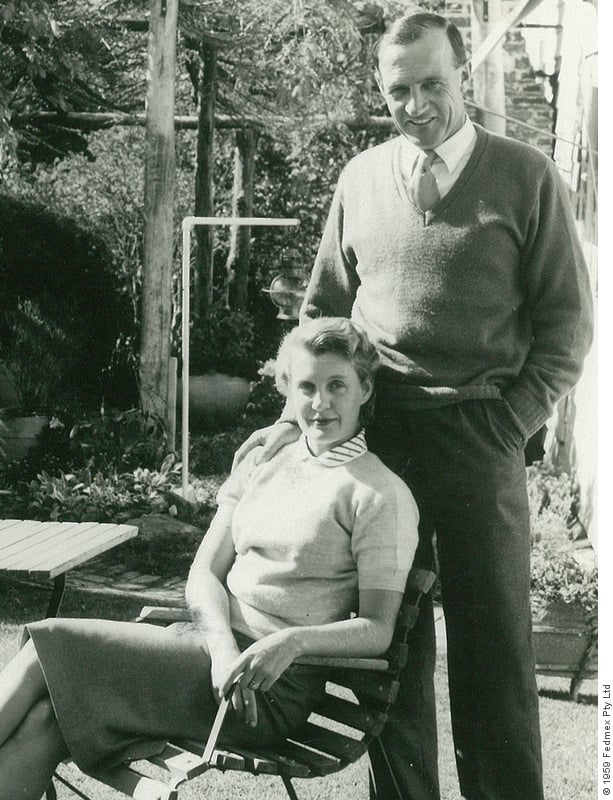
Jeremy’s parents Jill and Norman Griffith in 1959, at their 3,500 acre
sheep station ‘Totnes’, near Mumbil in central west New South Wales
The magnificence of my father Norman (1913-1971) was that he was not at all oppressively egocentric and instead was very saintly, strong but kind, especially never critical or egocentrically pushy and bullying like many men are, which was wonderful and very special for Jill, and for me.
The following two photos of Jill’s mother Enid and grandmother ‘Mackie’ show the exact same extremely independent-of-and-unimpressed-by-the-false-world, upright, sensible, no-alienated-nonsense, core strength expression that Jill had. In paragraph 810 of FREEDOM I explain how this extraordinary defiance of the corrupt world in my mother, in her mother and in her grandmother, is a remnant of the soul strength that all women had long ago when humanity was a nurturing-focused, matriarchal society.”

1963 photo of Jill’s mother Enid
Pountney (later Rush) (1902-1980)

Early 1900s photo of Jill’s grandmother Emily ‘Mackie’ McPherson (1875-1945)
In his writing Jeremy has explained that unlike resigned humans who are living in alienated denial of the truth of their own and the world’s horrifically corrupted condition, exceptional unresigned, denial-free thinkers (individuals we have historically referred to as ‘prophets’) were able to see clearly the horror of the suffering in everyone’s life, and that it was this extreme soul-sensitive ability to see and feel for all the suffering in the world that has been the deeper motivation behind his unrelenting, immense efforts to solve the human condition. His absolute determination and conviction to solve the human condition is perfectly expressed in this phrase, which Jeremy has used in every major document he has written: ‘Soon from one end of the horizon to the other will appear an army in its millions to do battle with human suffering and its weapon will be understanding.’

Jeremy’s re-creation of a 1972 drawing he did when he was 27 years old for a girlfriend to
accompany an astonishingly prescient inspiration he wrote to her about ‘a little boy
leading a great army that was like a thousand wild horses galloping across a vast plain’
In his amazingly insightful Freedom Essay 39 titled Christ explained, Jeremy describes how Christ’s alienation-and-denial-free ability to see and feel all the suffering in the human race similarly motivated his life’s mission. As Christ said, ‘I stood in the midst of the world and…found all men drunken [behaving in a mad way]…And my soul grieves over the sons of men, because they are blind in their heart, and see not [alienated from the truth of their horrifically corrupted condition]’ (Gospel of Thomas, saying 28). Jeremy explained that it was Christ’s extreme unresigned sensitivity to human suffering that led him, in the pre-scientific age in which Christ lived, to realise that he needed to create a religion around his soundness for people to defer to and live through. That religion, which has more followers than any other, is Christianity.
Jeremy also mentions that the great prophet Isaiah felt a similar call to action when ‘the Lord’—which, as Jeremy explains in Freedom Essay 23: Integrative Meaning or ‘God’, is the great overarching truth of the integrative meaning of existence—in effect said to him, ‘“Whom shall I send? And who will go for us?” And I [Isaiah] said, “Here am I. Send me!”’ (Isa. 6:8).
This book’s title, Jeremy Griffith: The biologist who solved the human condition so we can fix the world, reflects this unshakable vision of Jeremy’s to solve the human condition so that the human race is finally in a position to end all the human-condition-stricken suffering, and fix the world. (See Freedom Essay 51: Sir Laurens van der Post’s fabulous vision for much more description of Jeremy’s life-long vision to end the world’s suffering.)
Interestingly, and this is more related to the importance of nurturing than to the motivation of prophets, in 2026 Jeremy wrote the following about the work of two people, who, apart from his own, he says the world needs most at this point in time.
“Firstly, there is the current President of the United States Donald Trump, who has single-handedly stood up to and is putting a stop to the extremely addictive, ‘woke’, socialist, globalist ideology that makes you feel good and by so doing gives you relief from the now unbearable levels of suffering from the agony of the human condition but is actually an extremely selfish and dangerous form of pseudo idealism (as I explain in paragraph 115 of THE Interview, and more fully in my book Death by Dogma). I suspect that the key influence behind Trump’s extraordinary core strength was his mother Mary Anne (1912-2000) who came from the remote western isles of Scotland where some original core soul strength in women must still survive. I don’t know where my mother’s ancestors are from other than that they are from the British Isles, which as a whole have been relatively isolated from all the soul-corrupting upset that has been raging across the world. Unlike the very unusual saintly kindness of my father that kept me free of egocentricity, I think Trump’s father, like most human-condition-afflicted, self-worth-embattled men, was somewhat egocentrically oppressive of Trump’s soul, which has made Trump somewhat egocentric like most men are.

Mary Anne Trump (née MacLeod) in 1930
The second other person whose work I consider most needed in the world today, is that of courageous psychoanalyst Erica Komisar because in her book Being There: Why the First Three Years of Motherhood Matters, and in her many media appearances, Komisar emphasises the critical importance of nurturing infants during the first three years of their life. My ‘instinct vs intellect’ explanation of the human condition explains why the human race’s heroic search for knowledge caused us to become increasingly soul-corrupted with anger, egocentricity and alienation, and how that progression could only be relieved by the finding of the redeeming ‘instinct vs intellect’ explanation of our corrupted condition that we finally now have. In paragraph 75 of THE Interview, I included a graph (below) showing how the ever increasing levels of upset in humans, especially the levels of psychosis/alienation, have been increasing so rapidly lately that the line tracking their rise is near vertical with the amount of upset virtually doubling now in each new generation—such that the human race is entering the terrifying end play state of terminal levels of psychosis. In my various publications I describe this terminal state in dramatic terms, such as how many of the latest Z generation are finding themselves so crippled with psychological pain that they are unable to work, or even leave their house.

The race between self-destruction and self-understanding
What’s missing from all those descriptions is emphasis on the main reason that psychosis has been increasing so rapidly from generation to generation. Commentators blame the overuse of smart phones, and the destructive impact of the internet and social media, but these are only the effects of what is really going wrong. The real reason for the mental health crisis is the rapidly increasing failure of parents to adequately nurture their offspring—which is the danger Komisar has recognised and is alerting the world to, while trying as hard as possible to stop from happening. I pointed out the problem of this rapidly increasing lack of nurturing in chapter 8.16C of FREEDOM, which is titled ‘The dire consequences of terminal levels of alienation destroying our ability to nurture our children’, but my job is to focus on the overall problem of solving, and spreading the actual understanding of, the human condition, which is what has been needed to stop the increase in alienation in parents, and thus stop the increase in their inability to adequately nurture their offspring. What is so important about Komisar’s work is that despite being constantly attacked because, as the saying goes, ‘Parents would rather be accused of being an axe murderer than a bad mother or father’, she has boldly and bravely continued to promote awareness of just how critically important to the welfare of the human race are the first three years of an infant’s life. Two of the many interviews with her about the issue are How a narcissistic society created the mental health crisis (and vice versa) (Alliance for Responsible Citizenship, 21 Feb. 2025), and The Truth about Daycare, Nannies, and Working Moms (The Lila Rose Podcast, 14 Dec. 2023). You can view both at www.fixtheworldsources.com/315.
I might mention that at the beginning of the second of those interviews Komisar says, ‘I feel like women have lost their empathy for their children. Society depends upon healthy children that grow into healthy adults. There is nothing more important than raising children.’ But there actually has been something ‘more important than raising children’ and that has been humanity’s heroic but corrupting search for the redeeming and psychologically healing understanding of the human condition, the alienating effects of which are the reason why ‘women have lost their empathy for their children’. It is really that deeper understanding of our corrupted human condition that has been needed to enable love in all its forms to return to the human race.”
And this is where the redeeming nature of that explanation becomes especially important. It means that even this most sensitive issue of inadequate nurturing can finally be faced without blame, because parents’ diminishing ability to nurture has itself been an inevitable consequence of humanity’s heroic but corrupting search for understanding. The following passage from chapter 6:13 of FREEDOM, titled ‘Nurturing now becomes a priority’, makes the point explicit. As Jeremy explains: “now that we have found that very good reason why parents have been unable to nurture their children with anything like the unconditional love children instinctively expect and need, it is no longer necessary to deny the importance of nurturing both in the maturation of our species and in our own lives. Yes, with the arrival of understanding of the human condition the terrible guilt that parents have felt for not being able to adequately nurture their offspring departs. Parents can now understand that their inability to adequately love their offspring is not their fault, but the product of the ever-accumulating levels of upset in the human race as a whole that resulted from our species’ heroic 2-million-year search for knowledge, specifically for self-knowledge, understanding of why we conscious humans are good and not bad. So yes, we can finally now admit the importance of nurturing and turn our attention back to the nurturing of our offspring—in fact, it now becomes a matter of great urgency that we do both these things.”
3.3 FIX THE WORLD’s rising sun of freedom from the horror of the human condition
Towards the end of his 2016 book FREEDOM Jeremy wrote that “Bringing these understandings to the world has been an enormous effort for the tiny band that is the 50 Founding Members of FIX THE WORLD. It has been such a struggle and such a team effort that in the more than 20 years [now 30] that most of us have been involved there has hardly been a week go by when one of us hasn’t been prompted to say ‘we couldn’t have survived that attack on us’, or ‘we couldn’t have accomplished that critical task’, ‘if we were even one less in number’. We have fought so hard and for so long and been through so much together it really is like we are one organism—and, given all that we have managed to achieve together based on our love of this information and what it can do for the world, it is a superorganism, with each member acting as beacons out of Plato’s dark cave, lighting the way to humanity’s freedom for everyone.”
Now, in 2026, that pathway to freedom from the agony and horror of the human condition that the Founding Members of FIX THE WORLD have so heroically blazed is steadily growing into a fabulously exciting highway. We now have 185,000 followers on Facebook, 120,000 members in our Facebook group, and 150,000 subscribers to our YouTube channel, thousands of ‘daily ecstatic responses’ (see top of www.humancondition.com), and there are now over 80 FIX THE WORLD Centres in over 30 countries founded by our international supporters!
It is catching on everywhere how living in support of this redeeming, reconciling and rehabilitating explanation of the human condition finally brings about the dreamed-of liberation of humanity from the agony and horror of the human condition! We all in FIX THE WORLD love this depiction by Jeremy of everyone in the world joining the great sunshine army on the sunshine highway to the world in sunshine!

Drawing by Jeremy Griffith © 2017 Fedmex Pty Ltd
This photograph was taken in November 2024 in Sydney of ‘the rising sun’ formed by many of our Founding Members, including other precious FIX THE WORLD Members, some from other FIX THE WORLD Centres, and also some friends of FIX THE WORLD!

L to R: Front row: Doug Lobban, Ales Flisar*, Virginia Topete*, Marcus Rowell, Polly Watson, Brony FitzGerald; Second row: Annie Williams, Molly Shannon*, Jeremy Griffith, Lachlan Dunn*, Nicoletta Akritidis*, Nikola Tsivoglou*, Andreas Mavridis*, Chris Akritidis*, Genevieve Salter, Susan Armstrong, Tess Watson, James Press; Standing third and fourth rows: Jοhn Bіggs, Wendy Skelton, Anthony Landahl, Monica Kodet, Nick Shaw, Stacy Rodger, Anthony Cummins, Dr Carol Velásquez*, Εmmα Cullen-Ward, Ali Watson, Fiona Cullen-Ward, Tony Gowing, Sarah Colquhoun, Neil Duns, Stirling West, Prue Westbrook, Lachlan Colquhoun, Connor FitzGerald, Prue Watson, Felicity Jackson, Damon Isherwood, Tony Miall, Tim Macartney-Snape, James West, Sam Belfield, Tom Shannon*, Anna Fitzgerald, Εrіc Crοοke. *Other FIX THE WORLD Members or friends of FIX THE WORLD. Founding Members not present in this photo: Annabel Armstrong, Richard Biggs, Anthony Clarke, Lyn Collins, Steve Collins, Sally Edgar, Simon Griffith, Charlotte James, Lee Jones, Manus McFadyen, Rachel O’Brien, Will Salter, Pete Storey, Tim Watson.

Created J. Griffith & G. Salter © 2020 Fedmex Pty Ltd
Copyright
Jeremy Griffith: The biologist who solved the human condition so we can fix the world by Damon Isherwood & Fiona Cullen-Ward
Published in 2026 by WTM Publishing and Communications Pty Ltd
(ACN 103 136 778) (www.wtmpublishing.com).

FIX THE WORLD (FTW) is a global not-for-profit movement represented by FTW charities and centres around the world.
ISBN 978-1-74129-127-8
CIP – Biography, Biology, Philosophy, Psychology
COPYRIGHT NOTICE
This booklet is protected by copyright laws and international copyright treaty provisions. Our Terms of Use (which are located at www.humancondition.com/terms-of-use) apply to the materials in this booklet. You may reproduce any of the material in this booklet on or in another website, blog, podcast, newsletter, book, document, etc, provided that you do not modify the material reproduced, you include the following notice and link “Source: www.humancondition.com,
© Fedmex Pty Ltd”, and you otherwise comply with clause 3.3 of the Terms of Use. Please note that we responsibly conduct regular monitoring, including searches of the internet, and any reproduction of our material not considered appropriate or properly contexted by us will not be allowed. All rights are reserved.
Jeremy Griffith: The biologist who solved the human condition so we can fix the world copyright © Fedmex Pty Ltd (ACN 096 099 286) 2026. The moral rights of the authors Damon Isherwood and Fiona Cullen-Ward are asserted.
The drawings by Jeremy Griffith, copyright © Fedmex Pty Ltd (ACN 096 099 286) 1991-2026.
Trade marks: FIX THE WORLD, WORLD TRANSFORMATION MOVEMENT, WTM, and the arms-raised man before the rising sun logo, are registered trade marks of Fedmex Pty Ltd (ACN 096 099 286).
